For motorsport enthusiasts, an aluminum floor jack is an indispensable tool for track days, offering a crucial blend of lightweight portability, rapid lifting capabilities, and a low-profile design. These jacks, typically weighing 40-60 pounds, are essential for quick tire changes, brake inspections, and suspension adjustments on performance vehicles. Modern aluminum models, such as the Arcan ALJ3T or Pittsburgh 3-Ton, provide superior strength and speed compared to traditional steel jacks, making them ideal for the fast-paced demands of a racing circuit.
This guide explores the advantages of aluminum floor jacks for track use, highlights key features to consider, and presents our top five recommendations for 2026. Understanding these specialized tools will help you make an informed decision, ensuring smooth and safe track day operations.
What is a Floor Jack? Definition and Applications
A floor jack is a hydraulic lifting device designed to raise a vehicle off the ground, facilitating maintenance, repairs, and tire changes. Its fundamental mechanism involves a hydraulic system: pumping the handle forces hydraulic fluid into a cylinder, generating pressure that extends a ram and lifts the jack’s saddle. The long handle provides excellent leverage, allowing users to lift heavy loads with relatively minimal effort.
In the context of track days and performance automotive work, floor jacks are indispensable. They enable quick wheel swaps, essential for adapting to different track conditions or tire wear patterns. Mechanics and enthusiasts also rely on them for inspecting brakes, adjusting suspension components, or checking undercarriage aerodynamics. The ability to swiftly and safely lift a vehicle is critical, as time on a track day is precious, and meticulous preparation directly impacts performance and safety.
Popular Types of Floor Jacks on the Market
While various floor jack types exist, aluminum hydraulic models dominate the track day scene due to their specific advantages. Understanding the broader categories helps to appreciate the specialized nature of aluminum racing jacks.
Hydraulic Floor Jack
Hydraulic floor jacks, the most common type, utilize oil pressure to generate lifting force. They are characterized by their robust lifting capacity and relatively smooth operation.
- Pros: High lifting capacity, easy to control descent, readily available in various sizes and profiles. Often features dual-piston pumps for quicker lifts.
- Cons: Can be heavy if made of steel, requires regular hydraulic fluid checks.
- Applications: Versatile for home garages, professional workshops, and, in their aluminum iteration, for trackside support.
Pneumatic Floor Jack
Pneumatic floor jacks, also known as air jacks, harness compressed air to lift vehicles. These are typically found in high-volume professional settings where speed is paramount.
- Pros: Extremely fast lifting, minimal physical effort required, ideal for repetitive tasks.
- Cons: Requires an air compressor, can be noisy, generally more expensive.
- Applications: Large auto repair shops, commercial garages, and professional racing pit crews where dedicated air systems are present.
Mechanical Floor Jack
|
Our Picks for the Best Floor Jack in 2026
As an Amazon Associate I earn from qualifying purchases.
|
||
| Num | Product | Action |
|---|---|---|
| 1 | Floor Jack 2.5 Ton (5500 lbs), Low Profile Floor Jack with Single Piston Pump, Heavy Duty Steel Hydraulic Jack for Car, Jack for Car with Lifting Range 3.4'' to 14.6'' |

|
| 2 | DNA Motoring TOOLS-00234 Low Profile Hydraulic Trolley Service/Floor Jack, 2 Ton (4000 lbs) Capacity, Lifting Range 5.1"-13", Black |
|
| 3 | VEVOR 2.5 Ton Low Profile, Heavy-Duty Steel Racing Floor Jack with Single Piston Lift Pump, Lifting Range 3.35"-14.96" |
|
| 4 | Dewalt DWHT83550 TOUGHSERIES Construction Jack |
|
| 5 | Amazon Basics Hydraulic Floor and Portable Car Jack, 2.2 Short Ton/ 2 Metric Ton/ 2 Tonne / 2000 kg Capacity, Slow Release, Red |
|
| 6 | DNA Motoring Low Profile Hydraulic Trolley Service/Floor Jack, 2 Ton (4000 lbs) Capacity, Lifting Range 5.1"-13", Blue, TOOLS-00474 |
|
| 7 | 3 Ton Low Profile, Aluminum and Steel Racing Floor Jack with Dual Pistons Quick Lift Pump for Sport Utility Vehicle, Lifting Range 3-15/16" min to 18-5/16" max, Net Weight 58.5 lb, Red |
|
| 8 | 3 Ton Floor Jack (6600 lbs), Heavy Duty Hydraulic Jack for Car, Heavy-Duty Floor Jack with Single Piston Pump, Quick Lift Car Jack 3 ton with Lifting Range 5.5'' to 18.5'' |
|
| 9 | Floor Jack 3 Ton Capacity Fast Lift Service Jack Steel Heavy Duty Hydraulic Car Jack |
|
| 10 | Low Profile Floor Jack 3 Ton (6600 lbs), Heavy Duty Hydraulic Jack for Car, Heavy-Duty Floor Jack with Dual Pistons Quick Lift Pump, Car Floor Jack with Lifting Range 3-1/8'' to 19-7/8'' |
|
Mechanical floor jacks, such as scissor jacks, operate using a screw mechanism or lever system. They are often included with vehicles for emergency tire changes.
- Pros: Compact, lightweight, affordable.
- Cons: Limited lifting capacity, slow operation, requires significant manual effort, less stable than hydraulic jacks.
- Applications: Emergency roadside tire changes, very light-duty home maintenance. Not suitable for track day use or regular maintenance.
Comparing Floor Jack Types
| Criteria | Hydraulic Floor Jack | Pneumatic Floor Jack | Mechanical Floor Jack |
|---|---|---|---|
| Lifting Mechanism | Hydraulic fluid pressure | Compressed air | Screw/Lever system |
| Speed | Moderate to Fast (especially with dual pumps) | Very Fast | Very Slow |
| Effort Required | Moderate (pumping handle) | Minimal (air switch) | High |
| Portability | Varies (aluminum models are highly portable) | Moderate (requires compressor) | High (very compact) |
| Cost | Mid-range | High | Low |
| Typical Capacity | 2-5 tons | 2-20+ tons | 0.5-2 tons |
| Maintenance | Hydraulic fluid checks, seal inspection | Air line inspection, valve maintenance | Lubrication of screw/pivot points |
| Best for Track Days | ✅ Aluminum models are excellent | ✅ If pit crew setup available | ❌ Not recommended |
Guide to Choosing the Right Floor Jack for Track Days
Selecting the ideal floor jack for track days involves balancing performance, portability, and safety features. Given the specific demands of a racing environment, certain attributes become more critical than others.
Determine Usage Needs
Consider the type of vehicle you’ll be working on and how frequently you’ll be using the jack.
- Vehicle Type & Weight: Most track cars are performance vehicles, often lowered and weighing between 2,500 to 4,000 lbs. A 2-ton to 3-ton capacity jack is generally sufficient, providing a good safety margin. Always aim for a jack that can handle at least three-quarters of your vehicle’s total weight.
- Frequency of Use: For frequent track days, investing in a durable, high-quality aluminum jack with rapid lift features will save time and effort.
- Budget: While tempting to cut costs, safety and reliability should be paramount. High-quality aluminum jacks typically come at a higher price point but offer superior performance and longevity.
Key Factors When Selecting
Several specific features differentiate a good track-day jack from a standard garage model.
- Lifting Capacity (Max Load): Ensure the jack’s rated capacity comfortably exceeds the heaviest vehicle you plan to lift. For most performance cars, 2 to 3 tons (4,000 to 6,000 lbs) is appropriate.
- Minimum and Maximum Lift Height: Track cars often have very low ground clearance. Look for a jack with a low saddle height (e.g., 3-4 inches) to fit underneath. A good maximum lift height (e.g., 18-20+ inches) provides ample working space.
- Durability and Material Quality: Aluminum construction is vital for portability, but ensure it’s high-grade aircraft aluminum for strength. Look for robust welds and quality components.
- Brand Reputation: Trusted brands often signify better build quality, reliable customer service, and adherence to safety standards.
- Safety Features: Critical for any jack, but especially in a fast-paced track environment. Look for:
- Overload and Bypass Valves: Prevent lifting beyond the rated capacity and safeguard the hydraulic system.
- Rubber Lift Pads: Protect the vehicle’s frame and undercarriage from scratches and dents.
- Wide, Stable Base: Ensures stability, particularly when the vehicle is raised.
- Locking Mechanisms: Some jacks feature locks to prevent accidental lowering.
- Rapid Lift System: Dual-piston or “quick-pump” designs significantly reduce the number of pumps required to reach the lifting point, saving valuable time during pit stops or adjustments.
“Choosing the right jack isn’t just about lifting your car; it’s about making sure you’re safe and comfortable while doing maintenance.” – John Smith, Seasoned Mechanic and Author
Top Aluminum Floor Jack Brands for Track Days
Several manufacturers consistently produce high-quality aluminum floor jacks suitable for track use. While specific models vary, these brands are often praised for their durability, performance, and safety features:
- Arcan: Known for robust construction and quick-lift capabilities.
- NOS: Offers premium features and strong lifting power in lightweight designs.
- Pittsburgh (Harbor Freight): Popular for providing good value with capable racing jacks.
- Daytona (Harbor Freight): Offers professional-grade racing jacks with rapid pump technology.
- JEGS: A reputable name in automotive performance, offering lightweight and low-profile aluminum jacks.
- Yellow Jacket: Often highlighted for speed and precision, ideal for performance cars.
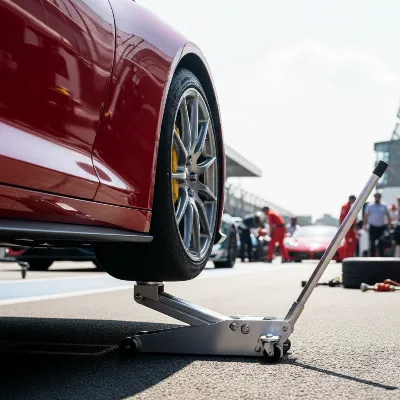 An aluminum floor jack lifting a low-profile sports car at a racetrack, with tools and tires nearby, illustrating portability and quick use.
Top 5 Best Aluminum Floor Jacks for Track Days in 2026
Here are our picks for the best aluminum floor jacks, combining lightweight design, rapid lift, low profile, and durability, perfect for track day enthusiasts.
1. Pittsburgh 3-Ton Low-Profile Aluminum Racing Jack
The Pittsburgh 3-Ton Low-Profile Aluminum Racing Jack is a perennial favorite among enthusiasts for its robust performance and excellent value. It’s specifically designed for vehicles with minimal ground clearance, making it an ideal choice for track cars and lowered vehicles. Weighing approximately 63 pounds, it strikes a good balance between portability and strength.
- Key Features: Low-profile design, 3-ton lifting capacity, aluminum construction for reduced weight, dual-piston pump for quick lifts.
- Why it’s great for track days: Its low profile ensures it fits under most lowered cars, while the aluminum build and dual-piston pump contribute to fast, efficient lifting at the track. It’s a reliable workhorse for routine maintenance and quick adjustments.
2. Arcan ALJ3T Quick Rise Aluminum Floor Jack
The Arcan ALJ3T stands out as an exceptional all-around aluminum jack, highly praised for its incredible lifting power and user-friendly design. It can lift most automobiles with ease, boasting a 3-ton capacity while weighing a mere 58 pounds. Its quick-rise mechanism is a significant advantage, ensuring less time spent pumping.
- Key Features: 3-ton capacity, quick-rise dual-pump pistons, wide lift range (3.6 inches to 19.4 inches approximately), lightweight (58 lbs), twist-handle lowering mechanism, rubber-padded saddle.
- Why it’s great for track days: The quick-rise action and lightweight design make it perfect for rapid wheel changes or inspections. Its impressive lift range accommodates various vehicles, and the safety features add peace of mind.
3. NOS 3-Ton Aluminum Service Jack
The NOS 3-Ton Aluminum Service Jack is a premium choice known for its massive lifting capabilities combined with a surprisingly light frame. Despite its 3-ton (6,000 lb) capacity, this powerhouse weighs only 58 pounds, making it incredibly portable. It also features an excellent range of motion and attractive safety features.
- Key Features: 3-ton capacity, lightweight aluminum construction, wide lifting range (approx. 3.15 inches to 19.3 inches), rubber lifting pad, rubber handle bumper, safety release valve.
- Why it’s great for track days: The combination of high capacity and low weight makes it versatile for various track vehicles. The safety release valve prevents overloading, a crucial feature in high-stress track environments.
4. DAYTONA 1.5 Ton Professional Racing Series Aluminum Floor Jack with RAPID PUMP
While a 1.5-ton capacity might seem lower, the DAYTONA Professional Racing Series jack is specifically engineered for speed and precision, making it perfect for lighter, dedicated race cars. Crafted from high-strength aluminum billet, it features an exclusive RAPID PUMP dual parallel pump system that lifts vehicles quickly with twice the height per pump. It also boasts a universal joint release mechanism for controlled descents.
- Key Features: 1.5-ton capacity, RAPID PUMP dual parallel pump system, high-strength aluminum billet construction, universal joint release, two-piece knurled steel handle with foam bumper.
- Why it’s great for track days: This jack is built for lightning-fast pit stops, needing only a 1/2-turn release for rapid lowering. Its quick-lift system and lightweight design are paramount for time-sensitive adjustments on lighter race vehicles.
5. Yellow Jacket 3-Ton Aluminum Racing Jack
The Yellow Jacket 3-Ton Aluminum Racing Jack is designed for speed and precision, making it particularly popular among automotive enthusiasts who work on performance cars. It offers a fast-lift design and a 3-ton capacity while maintaining a lighter profile than many steel alternatives. Its low entry design is a significant advantage for lowered vehicles.
- Key Features: 3-ton capacity, fast lift design, aluminum body for reduced weight, low entry design, wide saddle and stable base.
- Why it’s great for track days: This jack excels at quickly and safely lifting low-profile sports cars. Its reputation for combining racing-style speed with everyday durability makes it a solid choice for frequent track use.
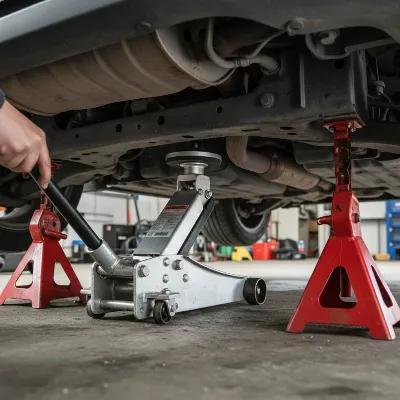 A close-up of a mechanic properly using an aluminum floor jack with jack stands under a car, highlighting safety features.
How to Safely Use a Floor Jack
Safety is paramount when working with any lifting equipment. Always follow these steps and precautions to prevent accidents.
Proper Usage Steps
- Park on a Flat, Stable Surface: Ensure your vehicle is on a hard, level, non-slip surface. Avoid gravel, grass, or sloped areas.
- Engage Parking Brake and Block Wheels: Apply the parking brake and place wheel chocks behind the wheels that will remain on the ground. For front-wheel lifts, chock the rear wheels; for rear-wheel lifts, chock the front wheels.
- Locate Jack Points: Consult your vehicle’s owner’s manual to identify the correct jacking points. Using incorrect points can damage your car or lead to instability.
- Position the Jack: Slide the floor jack under the designated jacking point, ensuring the saddle is centered and making full contact.
- Lift the Vehicle: Pump the jack handle slowly and steadily until the vehicle is raised to the desired height. Avoid jerky movements.
- Insert Jack Stands: Crucially, once the vehicle is lifted, immediately place sturdy jack stands under the appropriate support points. Never rely solely on the floor jack to support the vehicle.
- Lower Onto Stands: Slowly release the jack, allowing the vehicle to rest securely on the jack stands. The jack should then be removed or kept lightly touching for added security.
- Reverse Process: When finished, lift the vehicle slightly with the jack, remove the jack stands, and then slowly lower the vehicle completely to the ground.
Safety Precautions
- Never work under a vehicle supported only by a jack. Always use jack stands.
- Inspect your jack regularly. Check for leaks, damaged components, or unusual wear.
- Ensure the jack’s capacity matches or exceeds your vehicle’s weight.
- Wear appropriate safety gear, such as gloves and eye protection.
- Keep clear of the vehicle as it is being raised or lowered.
- Avoid using extensions or adapters unless specifically designed for your jack and application.
Maintenance and Care for Your Aluminum Floor Jack
Proper maintenance ensures your floor jack remains reliable and safe for years of track-day adventures.
- Clean After Use: Wipe down the jack with a clean cloth to remove dirt, grease, and grime. This prevents accumulation that could hinder performance or lead to corrosion.
- Check Hydraulic Fluid: Periodically check the hydraulic fluid level. If low, top it off with the manufacturer-recommended hydraulic jack oil. Bleed air from the system if the jack isn’t lifting properly.
- Inspect for Damage: Regularly examine the jack for any signs of wear, damage, or leaks. Look at the wheels, frame, handle, and especially the hydraulic cylinder and seals. Replace worn parts promptly.
- Lubricate Moving Parts: Apply a light lubricant to the wheels, pivot points, and release mechanism to ensure smooth operation.
- Store Properly: Store your floor jack in a clean, dry area, ideally in its lowest position to relieve pressure on the seals. Protect it from extreme temperatures and moisture to prevent rust and seal degradation.
Conclusion
For the dedicated track enthusiast, an aluminum floor jack is an essential investment, offering the critical combination of lightweight portability, rapid lifting capabilities, and a low-profile design necessary for efficient trackside maintenance. From the robust Arcan ALJ3T and NOS 3-Ton models to the quick-action Pittsburgh and Daytona Racing jacks, the market offers excellent options to meet the demanding pace of race day. Prioritizing features like lifting capacity, minimum saddle height, and crucial safety mechanisms ensures both performance and peace of mind.
the longevity and safe operation of your floor jack hinge on proper usage and consistent maintenance. Always pair your jack with sturdy jack stands, adhere to your vehicle’s designated lift points, and inspect your equipment regularly. With the right aluminum floor jack, you’ll spend less time struggling with equipment and more time enjoying the thrill of the track. What essential features do you value most in a floor jack for your track day preparations?
Frequently Asked Questions
What is the ideal weight capacity for an aluminum floor jack for track cars?
For most track cars, which are typically performance sedans or sports coupes, an aluminum floor jack with a 2-ton to 3-ton capacity is ideal. This range provides a sufficient safety margin for vehicles weighing between 2,500 and 6,000 lbs, ensuring safe and stable lifting for common track-day vehicles.
Why are aluminum floor jacks preferred over steel ones for track days?
Aluminum floor jacks are preferred for track days primarily due to their significantly lighter weight, making them much easier to transport to and from the track. Their reduced weight, often around 40-60 pounds, doesn’t compromise structural integrity and allows for quicker maneuvering in a pit or garage setting compared to heavier steel alternatives.
What does “low profile” mean in a floor jack, and why is it important for track cars?
“Low profile” refers to a floor jack’s minimum saddle height, allowing it to fit under vehicles with very limited ground clearance. Many track cars are lowered for improved aerodynamics and handling, making a low-profile jack (typically with a minimum height of 3-4 inches) essential to access jacking points without damaging the undercarriage.
How does a “rapid pump” or “quick lift” feature benefit track day users?
A rapid pump or quick lift feature, often achieved with dual-piston hydraulics, reduces the number of strokes required to raise a vehicle. For track day users, this translates to faster tire changes, brake checks, or suspension adjustments, saving crucial time when every second counts during a busy track schedule.
Are all aluminum floor jacks safe for heavy-duty use on track days?
While aluminum jacks are durable, their suitability for heavy-duty track use depends on the quality of construction and adherence to safety standards. Always choose models from reputable brands, ensure the lifting capacity exceeds your vehicle’s weight, and verify it includes safety features like overload valves and a stable base to ensure reliable and safe operation.
How to Safely Use a Floor Jack
Follow these steps to safely lift your vehicle using a floor jack and jack stands, preventing accidents during maintenance.
Park your vehicle on a hard, level, non-slip surface. Engage the parking brake and place wheel chocks behind the wheels that will remain on the ground to prevent movement.
Consult your vehicle's owner's manual to identify the correct jacking points. Slide the floor jack under the designated point, ensuring the saddle is centered and makes full contact with the vehicle's frame.
Pump the jack handle slowly and steadily until the vehicle is raised to the desired height. Immediately place sturdy jack stands under the appropriate support points. Never rely solely on the floor jack to support the vehicle.
Slowly release the jack, allowing the vehicle to rest securely on the jack stands. The floor jack should then be removed or kept lightly touching for added security, but the primary support must be the jack stands.
When finished, lift the vehicle slightly with the jack, remove the jack stands, and then slowly lower the vehicle completely to the ground. Always keep clear of the vehicle as it is being raised or lowered.

I got the Pittsburgh 3-Ton model based on the mention of its strength. It does lift well, and it’s definitely lighter than my old jack, but I found the handle a bit wobbly after a few uses. It still gets the job done for suspension adjustments at the track, but I expected a slightly more robust feel for the price range. Good for occasional use, but maybe not for heavy-duty daily shop work.
I picked up the Arcan ALJ3T after reading about it here, and it’s been a game-changer for my track days. The lightweight portability is exactly what I needed, making it super easy to load and unload from the trailer. It lifts my Mustang GT quickly and smoothly for tire changes, which saves so much time between sessions. Definitely a solid recommendation for anyone serious about racing.
This guide really helped me narrow down my choices. I ended up going with one of the recommended low-profile designs, and it fits perfectly under my lowered Subaru BRZ. It’s much faster than my old steel jack, and the rapid lifting capabilities are a huge plus when I’m trying to get a quick look at the brakes. Only wish it came with a better storage case, but that’s minor.
As a motorsport enthusiast, I can confirm an aluminum floor jack is truly indispensable. The information about the 40-60 pound weight range was spot on, and it makes a huge difference when you’re hauling gear to the circuit. I use mine for quick tire changes and it’s been flawless. Couldn’t imagine going back to a heavier steel jack now.