For serious truck maintenance, a 4-ton heavy-duty floor jack is essential, offering unwavering strength, stability, and safety for lifting large vehicles up to 8,000 pounds. These jacks, like the Daytona 4-Ton Professional or Big Red AT84007R, utilize hydraulic systems to provide controlled lifting, making them indispensable tools in both professional garages and home workshops for tasks ranging from tire rotations to complex suspension work. Always supplement a floor jack with jack stands for safe, sustained vehicle support.
What is a Floor Jack?
A floor jack is a fundamental piece of automotive equipment engineered to safely lift vehicles off the ground, providing crucial access for maintenance and repair tasks. Utilizing a hydraulic system, these jacks convert a small input force into a large output force, enabling them to raise even the heaviest trucks with relative ease. Floor jacks are indispensable tools in both professional garages and home workshops, facilitating everything from routine tire rotations and oil changes to complex suspension work and component replacements on large vehicles. Their primary function is to provide temporary, controlled lifting, which must always be supplemented with jack stands for safe, sustained vehicle support.
Popular Types of Floor Jacks on the Market
Understanding the various types of floor jacks helps in selecting the right tool for specific lifting needs, especially when dealing with the substantial weight of big trucks. While all aim to lift, their mechanisms and ideal applications differ significantly.
Hydraulic Floor Jack (Trolley Jack)
Hydraulic floor jacks, often referred to as trolley jacks, are the most common and versatile type for automotive use. They employ a hydraulic cylinder and fluid to generate immense lifting power.
- Pros: They offer significant lifting capacity, making them ideal for a wide range of vehicles, including heavy-duty trucks. Their wheeled design allows for easy positioning under the vehicle, and modern versions often feature dual-piston pumps for rapid lifting.
- Cons: These jacks can be heavy and bulky, especially those constructed from steel for heavy-duty applications, requiring considerable storage space. They also necessitate periodic maintenance of their hydraulic fluid.
- Applications: Professional auto repair shops, home garages for general vehicle maintenance, and heavy-duty applications involving trucks, SUVs, and commercial vehicles.
Pneumatic Floor Jack (Air Jack)
Pneumatic floor jacks, or air jacks, utilize compressed air to lift vehicles. They are known for their speed and efficiency, making them popular in fast-paced environments.
- Pros: They provide exceptionally fast and effortless lifting with minimal manual input, significantly reducing the time required for repetitive tasks. This makes them highly efficient in busy workshops.
- Cons: A primary drawback is the necessity of an external air compressor, adding to the initial cost and equipment footprint. They can also be quite noisy during operation due to the compressed air release.
- Applications: Large-scale automotive repair facilities, industrial settings, and production lines where rapid and frequent lifting of heavy vehicles or equipment is a constant requirement.
Mechanical Floor Jack
|
Our Picks for the Best Floor Jack in 2026
As an Amazon Associate I earn from qualifying purchases.
|
||
| Num | Product | Action |
|---|---|---|
| 1 | VEVOR 2.5 Ton Low Profile, Heavy-Duty Steel Racing Floor Jack with Single Piston Lift Pump, Lifting Range 3.35"-14.96" |

|
| 2 | 3 Ton Floor Jack (6600 lbs), Heavy Duty Hydraulic Jack for Car, Heavy-Duty Floor Jack with Single Piston Pump, Quick Lift Car Jack 3 ton with Lifting Range 5.5'' to 18.5'' |
|
| 3 | Low Profile Floor Jack 3 Ton (6600 lbs), Heavy Duty Hydraulic Jack for Car, Heavy-Duty Floor Jack with Dual Pistons Quick Lift Pump, Car Floor Jack with Lifting Range 3-1/8'' to 19-7/8'' |
|
| 4 | DNA Motoring TOOLS-00234 Low Profile Hydraulic Trolley Service/Floor Jack, 2 Ton (4000 lbs) Capacity, Lifting Range 5.1"-13", Black |
|
| 5 | 3 Ton Low Profile, Aluminum and Steel Racing Floor Jack with Dual Pistons Quick Lift Pump for Sport Utility Vehicle, Lifting Range 3-15/16" min to 18-5/16" max, Net Weight 58.5 lb, Red |
|
| 6 | Dewalt DWHT83550 TOUGHSERIES Construction Jack |
|
| 7 | Floor Jack 3 Ton Capacity Fast Lift Service Jack Steel Heavy Duty Hydraulic Car Jack |
|
| 8 | Amazon Basics Hydraulic Floor and Portable Car Jack, 2.2 Short Ton/ 2 Metric Ton/ 2 Tonne / 2000 kg Capacity, Slow Release, Red |
|
| 9 | Floor Jack 2.5 Ton (5500 lbs), Low Profile Floor Jack with Single Piston Pump, Heavy Duty Steel Hydraulic Jack for Car, Jack for Car with Lifting Range 3.4'' to 14.6'' |
|
| 10 | DNA Motoring Low Profile Hydraulic Trolley Service/Floor Jack, 2 Ton (4000 lbs) Capacity, Lifting Range 5.1"-13", Blue, TOOLS-00474 |
|
Mechanical floor jacks, such as scissor jacks or screw jacks, operate using a manual screw mechanism or leverage system. They are typically found with passenger vehicles for emergency use.
- Pros: These jacks are generally compact, lightweight, and very affordable, making them easy to store in a vehicle for roadside emergencies. Their simple design requires minimal maintenance.
- Cons: They have limited lifting capacity, making them unsuitable for heavy trucks. They also require significant manual effort and are considerably slower to operate compared to hydraulic or pneumatic options.
- Applications: Primarily used for emergency tire changes or minor roadside repairs on lighter passenger vehicles. They are not recommended for heavy-duty truck maintenance due to their inherent limitations in capacity and stability.
Comparison of Floor Jack Types
Choosing the best floor jack for your needs requires a careful comparison of the various types against key criteria. This table highlights the essential differences to help you decide.
| Feature | Hydraulic Floor Jack (Trolley) | Pneumatic Floor Jack (Air) | Mechanical Floor Jack (Scissor) |
|---|---|---|---|
| Lifting Capacity | High (2-10+ tons, common 4-ton for trucks) | Very High (1-75+ tons) | Low (0.5-2 tons) |
| Lifting Speed | Moderate to Fast (especially dual-pump) | Very Fast | Slow |
| Ease of Use | Easy (lever action) | Very Easy (button/valve control) | Difficult (manual cranking) |
| Portability | Low to Moderate (heavy, wheeled) | Moderate (lighter, but needs air supply) | High (lightweight, compact) |
| Cost | Moderate to High | High (plus compressor cost) | Low |
| Required Equipment | None (self-contained hydraulic) | Air Compressor | None (manual) |
| Stability | High (wide base, long chassis) | High (wide base) | Low (narrow base) |
| Maintenance | Hydraulic fluid checks | Air compressor maintenance | Minimal |
| Typical Use | Garage/shop repairs, heavy vehicle maintenance | Commercial shops, industrial, rapid lifting | Emergency roadside repairs, light vehicles |
Top 5 Best 4 Ton Heavy Duty Floor Jacks for Big Trucks
When it comes to lifting substantial vehicles like big trucks, a 4-ton heavy-duty floor jack is an indispensable tool, offering the necessary capacity and robust construction. Here are five top contenders known for their reliability, performance, and features tailored for demanding tasks.
1. Daytona 4-Ton Professional Floor Jack with RAPID PUMP
The Daytona 4-Ton Professional Floor Jack from Harbor Freight is highly regarded for its robust construction and efficient lifting capabilities, making it a favorite among both DIY enthusiasts and professionals working on big trucks. This jack combines power with speed, designed to handle demanding tasks with ease.
- Key Features: It boasts a 4-ton (8,000 lb) lifting capacity and a versatile lift range from 4-1/4 inches to 20-1/4 inches, accommodating a wide array of vehicles including low-profile cars to heavy-duty trucks. The dual-piston RAPID PUMP technology allows it to reach maximum height in as few as 3-1/2 pumps. Constructed from 100% precision-welded steel, it features high-strength, rust-resistant hardware, ball-bearing premium rear swivel casters for 360° mobility, and a rotating, removable jack saddle. An industrial-strength powder-coat finish ensures durability, and it complies with ASME-PASE industry standards for safety.
- Pros: Offers extremely fast lifting, is built with durable, heavy-duty steel, provides excellent maneuverability, and delivers great value for its performance.
- Cons: At 102 pounds, its significant weight can make it challenging to move around smaller garages or transport frequently.
2. Big Red AT84007R Hydraulic Garage Floor Jack
The Big Red AT84007R by Torin Jacks is a formidable 4-ton hydraulic floor jack explicitly designed for the rigorous demands of trucks and larger vehicles, earning recognition as a “Best Jack for Trucks” by automotive experts. Its combination of speed, power, and safety makes it a top choice for heavy-duty lifting.
- Key Features: This jack features a 4-ton (8,000 lb) load capacity with a lifting range of 4 inches to 20 inches, suitable for various cars, SUVs, and heavy-duty trucks. It incorporates a dual-piston pump that significantly accelerates lifting, reportedly up to five times faster than single-pump jacks. Equipped with two large steel casters and two 360-degree swivel casters, it ensures smooth and controlled movement. Safety is paramount with a built-in overload system to prevent unsafe operation beyond its rated capacity, and it meets American Society of Mechanical Engineers (ASME) safety standards. The jack is constructed from powder-coated steel for enhanced durability.
- Pros: Exceptional lifting capacity and speed thanks to its dual-piston design, robust safety features, and highly durable steel construction.
- Cons: Weighing approximately 100.8 pounds, it is heavy and less portable than aluminum alternatives. Its 20-inch maximum lift height might not be sufficient for extremely tall or lifted trucks.
3. Arcan 4-Ton Steel Hydraulic Floor Jack
Arcan is a brand synonymous with quality and reliability in automotive lifting equipment, and their 4-ton steel hydraulic floor jack exemplifies this reputation. It’s engineered for professional use, offering impressive lifting power and stability for trucks and other heavy vehicles.
- Key Features: This heavy-duty floor jack features an impeccable 4-ton capacity. It is equipped with universal joint technology, which provides a more controlled descent for added safety. A twin hydraulic system ensures faster and more efficient lifting. The two-piece handle facilitates easy positioning, pumping, and convenient storage. Rear-mounted swivel casters enhance maneuverability, while a pinned and padded saddle offers quick lift engagement and protects the vehicle’s undercarriage. Flanged side plates are integrated into its design for enhanced sturdiness and increased stability during heavy lifts.
- Pros: Excellent controlled descent, rapid lifting due to twin hydraulics, enhanced stability from flanged side plates, and robust steel construction for longevity.
- Cons: As a steel-constructed heavy-duty jack, it will be quite heavy, impacting portability. Specific lift range details might vary by model but are generally suitable for heavy vehicles.
4. Hein-Werner HW93657 4-Ton Long Chassis Service Jack
Regarded as an “American-made titan” in the lifting world, the Hein-Werner HW93657 is a professional-grade, long-chassis service jack built for the most demanding truck and heavy vehicle lifting tasks. Its substantial build and impressive lift range underscore its commercial viability.
- Key Features: This jack boasts a genuine 4-ton capacity and is built with a heavy-duty, 219-pound construction, emphasizing its robust nature. Its 49-inch long chassis allows for deep reach under vehicles with long overhangs, critical for many trucks and buses. A dual-piston pump system provides powerful and quick lifting. It offers a wide lifting range, from a low 5-inch minimum height to an impressive 25-3/4 inch maximum height, accommodating a diverse range of vehicle clearances. The jack features a sealed hydraulic unit for protection against contaminants and a durable cast lift arm, ensuring consistent performance under heavy loads. A three-position adjustable T-handle with a release knob provides precise control.
- Pros: Extremely durable American-made construction, exceptional long chassis for extended reach, high maximum lift height, and precise control for safe operation.
- Cons: Its significant weight (219 lbs) makes it less portable and more suited for a dedicated workshop or garage environment. The high-quality construction typically comes with a premium price tag.
5. Caterpillar 4-Ton All-in-One Jack (Bottle Jack Style)
While distinct from a traditional trolley floor jack, the Caterpillar 4-Ton All-in-One jack offers a unique heavy-duty solution for trucks in a compact, bottle jack style. Its integrated safety features and specific design address particular lifting challenges.
- Key Features: This jack provides a 4-ton (8,000 lb) lifting and holding capacity, making it suitable for trucks, SUVs, and other higher-clearance vehicles. Unlike conventional bottle jacks, it features a manually adjustable riser that minimizes the empty pumping strokes needed to reach the vehicle’s lift point. A standout feature is its built-in automatic locking system, which secures the load at height and eliminates the need for separate jack stands, enhancing safety and convenience. Constructed from alloy steel, it offers a lift range from 11 inches to 21 inches.
- Pros: Combines lifting and holding, negating the need for separate jack stands, adjustable riser reduces effort, and compact size for storage.
- Cons: As a bottle jack, it lacks wheels, which limits its mobility and positioning flexibility compared to trolley jacks. Its 21-inch maximum lift may not be sufficient for highly lifted trucks, and its smaller footprint inherently offers less lateral stability than a long-chassis floor jack.
How to Choose the Right Floor Jack for Your Needs
Selecting the ideal floor jack, especially a 4-ton heavy-duty model for trucks, involves evaluating several key factors to ensure it meets your specific requirements for safety, efficiency, and durability. Making an informed decision prevents frustration and ensures effective vehicle maintenance.
Determine Usage Needs
Before diving into specifications, consider how and where you’ll primarily use the jack.
- Type of Vehicle (Weight): The most critical factor is the Gross Vehicle Weight Rating (GVWR) of your truck. A 4-ton jack is suitable for vehicles up to 8,000 pounds. Always choose a jack rated for at least three-quarters of your truck’s total weight, providing a safety margin.
- Frequency of Use: For occasional DIY projects, a robust steel hydraulic jack might suffice. For professional shops or frequent heavy-duty work, invest in models with advanced features like rapid pumps and enhanced durability.
- Budget: While cost is a factor, prioritize safety and capacity over saving a few dollars. A higher upfront investment in a quality 4-ton heavy-duty floor jack can prevent accidents and costly repairs in the long run.
Key Factors to Consider When Buying
Once your needs are clear, focus on these technical specifications and features to narrow down your choices.
- Lifting Capacity (Maximum Load): Ensure the jack’s rated capacity (e.g., 4 tons or 8,000 lbs) comfortably exceeds your truck’s weight. This is non-negotiable for safety.
- Lifting Height (Minimum and Maximum): Check the minimum clearance required to slide the jack under your truck’s lowest lift points. For lifted trucks, a higher maximum lift height is crucial to get tires off the ground and allow sufficient space for jack stands.
- Durability and Material Quality: Heavy-duty steel construction is generally preferred for 4-ton jacks due to its superior strength and longevity. Look for precision welding, high-quality hardware, and robust finishes like powder coating to resist rust and wear.
- Brand Reputation and Supplier Trustworthiness: Opt for reputable brands known for manufacturing reliable lifting equipment. A strong warranty and readily available replacement parts are also indicators of a trustworthy supplier.
- Safety Features: Essential safety mechanisms include overload protection valves (to prevent lifting beyond capacity), bypass devices (to prevent over-pumping), and secure release controls for controlled lowering. Always remember that a floor jack is for lifting, and separate jack stands are vital for supporting the vehicle while you work underneath.
Top Reputable Floor Jack Brands
While the “best” jack often comes down to individual needs, several brands consistently receive high praise for their quality, innovation, and durability in the heavy-duty sector.
- Daytona (Harbor Freight): Known for offering professional-grade performance at competitive prices. Their 4-ton models, particularly with the RAPID PUMP technology, are highly rated for speed and robust steel construction.
- Torin (Big Red): A long-standing name in automotive tools, Torin’s Big Red line offers reliable and feature-rich jacks. The Big Red AT84007R is specifically lauded for its truck-lifting capabilities, dual-piston system, and adherence to safety standards.
- Arcan (often associated with American Forge & Foundry components): Arcan jacks are praised for their heavy-duty construction, smooth operation, and incorporation of advanced hydraulic systems for efficient and controlled lifting. They are a solid choice for professional environments.
- Hein-Werner: Considered a premium brand, Hein-Werner produces highly durable, American-made jacks often favored by seasoned professionals. Their long-chassis 4-ton models are built to last, providing extensive reach and superior stability for heavy vehicles.
- Caterpillar: While more known for heavy machinery, their branded jacks, like the 4-ton All-in-One, offer unique features like integrated locking systems in a bottle jack format, providing specialized solutions for truck owners who prefer a compact design without sacrificing capacity or safety.
> “Investing in a 4-ton heavy-duty floor jack is a non-negotiable for any serious truck owner or mechanic. The robust construction and advanced safety features of these jacks provide peace of mind, allowing you to focus on the task at hand rather than the integrity of your lifting equipment.” – Admin, ReviewHoster.com
Safe Use of a Floor Jack
Using a floor jack, especially a heavy-duty 4-ton model, demands strict adherence to safety protocols to prevent accidents and injuries. A floor jack is designed for lifting, not for sustaining a load, so always be vigilant.
Steps to Use a Floor Jack Correctly:
- Park on a Flat, Level Surface: Always ensure your truck is parked on stable, level ground. Uneven surfaces can cause the jack to shift or tip, leading to a catastrophic failure.
- Engage Parking Brake and Block Wheels: Set the parking brake firmly. Then, place wheel chocks on the wheels opposite the end of the vehicle you intend to lift. This prevents any unintended rolling.
- Locate Official Lift Points: Consult your truck’s owner’s manual to identify the correct jacking points. These are typically reinforced areas on the frame rails, cross members, or axle. Using incorrect points can damage the vehicle or cause the jack to slip.
- Position the Jack: Slide the floor jack under the designated lift point. Ensure the jack saddle is centered and securely in contact with the lifting point. If using a bottle jack, ensure it is on a stable base.
- Lift the Vehicle Slowly: Operate the jack handle with smooth, controlled strokes to raise the vehicle gradually. Keep an eye on the jack and the vehicle for any signs of instability or shifting. Lift only to the height necessary to place jack stands.
- Place Jack Stands: Once the vehicle is at the desired height, immediately place appropriately rated jack stands under the vehicle’s designated support points (also found in your owner’s manual), which are usually different from the jacking points. These stands provide mechanical support, unlike the hydraulic jack, which can lose pressure.
- Lower onto Jack Stands: Slowly and carefully lower the vehicle until its weight rests securely on the jack stands. Double-check that the stands are stable and properly seated before proceeding.
- Remove the Floor Jack: Once the vehicle is safely supported by jack stands, the floor jack can be removed, as it is no longer needed to bear the load.
Safety Precautions and Accident Prevention:
- Never Work Under a Vehicle Supported Only by a Floor Jack: This is the golden rule of vehicle lifting. Hydraulic systems can fail without warning. Always use jack stands.
- Inspect Your Jack Before Each Use: Check for any leaks, damage, or wear on the hydraulic components, frame, or wheels. Do not use a damaged jack.
- Keep Clear of the Vehicle’s Path: When lifting or lowering, ensure no one is under or too close to the vehicle. Maintain a safe distance.
- Do Not Exceed Capacity: Never attempt to lift a vehicle that exceeds the jack’s rated capacity. Overloading can lead to immediate failure.
- Avoid Using Extensions or Adapters Not Approved by the Manufacturer: Using improvised extensions can compromise stability and safety.
- Wear Appropriate Safety Gear: Gloves, safety glasses, and sturdy footwear are recommended when working with heavy equipment.
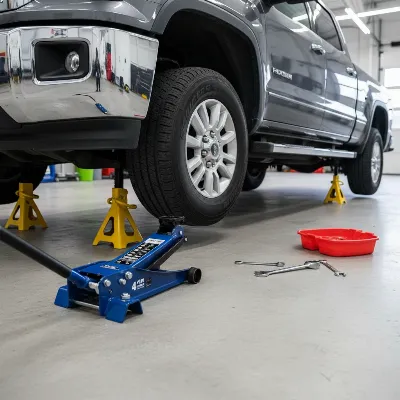 An illustration of a heavy-duty floor jack safely lifting a large truck, with separate jack stands securely in place under the vehicle's frame, demonstrating correct safety procedures for automotive maintenance.
Maintenance and Care for Your Floor Jack
Proper maintenance of your 4-ton heavy-duty floor jack is crucial to ensure its longevity, optimal performance, and, most importantly, continued safety. Regular care prevents malfunctions and preserves your investment.
- Clean Your Floor Jack After Each Use: Wipe down the jack with a clean cloth to remove dirt, grease, and grime. Pay special attention to the ram, pump assembly, and release valve to prevent buildup that could affect performance.
- Inspect for Damage and Wear: Regularly check for any signs of hydraulic fluid leaks, bent or cracked components, loose hardware, or damaged wheels/casters. Address any issues promptly, seeking professional repair or replacement parts if necessary.
- Check and Replace Hydraulic Fluid Periodically: Over time, hydraulic fluid can degrade or become contaminated. Consult your owner’s manual for the recommended inspection and replacement intervals (typically every 1-2 years for regular use, or more frequently for heavy commercial use). Use only the manufacturer-specified hydraulic jack oil.
- Lubricate Moving Parts: Apply a light coating of general-purpose grease or oil to the pivot points, casters, and any other moving mechanical parts to ensure smooth operation and prevent corrosion.
- Store in a Dry, Safe Place: When not in use, store your floor jack in a clean, dry environment, preferably with the ram fully retracted to prevent rust and protect the seals. Avoid exposing it to extreme temperatures or harsh chemicals.
- Never Modify Your Floor Jack: Do not attempt to modify any part of the jack, as this can compromise its structural integrity and safety features, voiding warranties and potentially leading to dangerous failures.
Conclusion
Choosing the right 4-ton heavy-duty floor jack is a critical decision for anyone working with big trucks, directly impacting safety, efficiency, and the quality of maintenance performed. From the rapid lifting of the Daytona Professional and Big Red AT84007R to the robust construction of the Arcan and the long-reach capability of the Hein-Werner, each of these top models offers exceptional power and durability. Even the specialized Caterpillar All-in-One provides a unique, integrated safety solution for specific needs. Understanding the distinct features and adhering to strict safety protocols are paramount, ensuring your investment not only elevates your vehicle but also your confidence in every task. What heavy-duty lifting challenge will you conquer next with your new, reliable floor jack?
Frequently Asked Questions
What is the primary difference between a 4-ton floor jack and a 4-ton bottle jack?
A 4-ton floor jack typically refers to a trolley-style jack with a long frame and wheels, offering greater stability and reach. A 4-ton bottle jack is more compact, uses a vertical ram, and is better for confined spaces but often less stable laterally, usually requiring a broader base or careful placement for trucks.
How much weight can a 4-ton heavy-duty floor jack actually lift?
A 4-ton heavy-duty floor jack is rated to lift up to 8,000 pounds (4 tons x 2,000 pounds/ton). This capacity is ideal for most large pickup trucks, SUVs, and even some smaller commercial vehicles, providing a safe margin for their Gross Vehicle Weight Rating (GVWR).
Is a dual-piston pump essential for a heavy-duty floor jack?
While not strictly essential, a dual-piston pump significantly enhances the efficiency of a heavy-duty floor jack by allowing it to lift the vehicle much faster with fewer pump strokes. This feature is highly recommended for frequent use or professional environments where time is a critical factor.
Why do I need jack stands even with a high-quality 4-ton floor jack?
Jack stands are crucial because a floor jack is a hydraulic device designed for lifting, not for prolonged support. Hydraulic systems can fail or leak over time, leading to unexpected drops. Jack stands provide a stable, mechanical backup, ensuring the vehicle remains securely elevated while you work underneath, preventing serious injury.
What minimum and maximum lift heights should I look for in a 4-ton floor jack for trucks?
For trucks, look for a minimum lift height that can clear your vehicle’s lowest jacking points (often around 4-6 inches for standard trucks, or potentially higher for lifted trucks). A maximum lift height of at least 20-25 inches is generally recommended to provide ample working room and allow for full suspension articulation, ensuring tires are well off the ground.
Frequently Asked Questions
What is the primary difference between a 4-ton floor jack and a 4-ton bottle jack?
A 4-ton floor jack is typically a trolley-style jack with a long frame and wheels, offering greater stability and reach for automotive tasks. In contrast, a 4-ton bottle jack is more compact with a vertical ram, suitable for confined spaces but generally provides less lateral stability, often requiring careful placement for trucks.
How much weight can a 4-ton heavy-duty floor jack actually lift?
A 4-ton heavy-duty floor jack is rated to lift up to 8,000 pounds (4 tons). This capacity is ideal for most large pickup trucks, SUVs, and even some smaller commercial vehicles, providing a safe margin for their Gross Vehicle Weight Rating (GVWR).
Is a dual-piston pump essential for a heavy-duty floor jack?
While not strictly essential, a dual-piston pump significantly enhances the efficiency of a heavy-duty floor jack by allowing it to lift a vehicle much faster with fewer pump strokes. This feature is highly recommended for frequent use or professional environments where time is a critical factor, such as with the Daytona RAPID PUMP technology.
Why do I need jack stands even with a high-quality 4-ton floor jack?
Jack stands are crucial because a floor jack is a hydraulic device designed for lifting, not for prolonged support. Hydraulic systems can fail or leak over time, leading to unexpected drops. Jack stands provide a stable, mechanical backup, ensuring the vehicle remains securely elevated while you work underneath, preventing serious injury.
What minimum and maximum lift heights should I look for in a 4-ton floor jack for trucks?
For trucks, look for a minimum lift height that can clear your vehicle's lowest jacking points, typically around 4-6 inches for standard trucks. A maximum lift height of at least 20-25 inches is generally recommended to provide ample working room and allow for full suspension articulation, ensuring tires are well off the ground.
How to Safely Use a 4-Ton Heavy-Duty Floor Jack
Learn the essential steps to safely lift a truck using a 4-ton heavy-duty floor jack and jack stands, preventing accidents and ensuring vehicle stability.
Always park your truck on a flat, level surface and engage the parking brake. Place wheel chocks on the wheels opposite the end of the vehicle you intend to lift to prevent any unintended rolling.
Consult your truck's owner's manual to identify the correct, reinforced jacking points. Slide the floor jack under the designated lift point, ensuring the jack saddle is centered and securely in contact with the lifting point.
Operate the jack handle with smooth, controlled strokes to gradually raise the vehicle to the desired height. Immediately place appropriately rated jack stands under the vehicle's designated support points, which are usually different from the jacking points.
Slowly and carefully lower the vehicle until its weight rests securely on the jack stands, double-checking that they are stable and properly seated. Once the vehicle is safely supported, remove the floor jack, as it is no longer needed to bear the load.

This 4-ton jack does the job for my Silverado, but I’ve noticed the hydraulic system can be a little slow to lower sometimes. It’s not a dealbreaker, and it still lifts fine, but it’s something to be aware of. For the price, it’s decent, but I might look for something with a faster release next time. Always use jack stands, of course.
I finally upgraded to a 4-ton heavy-duty floor jack, and it’s a game changer for my F-250. Lifting my truck for tire rotations used to be a real struggle with my old 2-ton, but this new one handles it with ease. The stability is incredible, and I feel much safer working under the vehicle now. Definitely worth the investment for anyone with a big truck.
I’m a professional mechanic, and I’ve been using the Daytona 4-Ton Professional for a few months now. It’s incredibly robust and handles everything from heavy-duty pickups to commercial vans with no issues. The controlled lifting mechanism is super smooth, making precise positioning easy. This jack is built to last and has become an indispensable tool in my shop.
I picked up the Big Red AT84007R after reading about it, and it’s been solid for my home garage. It lifts my Ram 1500 without breaking a sweat, which is exactly what I needed for suspension work. My only minor complaint is that it’s pretty heavy to move around, but I guess that’s expected for a heavy-duty unit. Still, it performs great.