Working on a lowered car presents unique challenges due to minimal ground clearance, making standard maintenance difficult. A low-profile floor jack is essential for safely reaching jacking points without damaging the undercarriage. These specialized jacks feature a minimum saddle height of 3 to 4 inches or less, allowing them to fit under vehicles with reduced clearance, such as sports cars and modified sedans. This guide details the best low-profile floor jacks, crucial buying considerations, and safe usage practices for 2026.
What is a Floor Jack and Why is it Essential for Lowered Cars?
A floor jack, also known as a car jack or trolley jack, is a hydraulic device designed to lift heavy vehicles off the ground for maintenance or repair. It operates on the principle of hydraulic pressure, where a small force applied to a piston transmits a larger force to another piston, enabling the lifting of significant weight with relative ease. For lowered cars, these conventional jacks often pose a major problem. Standard floor jacks typically have a minimum saddle height of 5 to 7 inches, which is often too high to fit under vehicles with reduced ground clearance, such as sports cars, modified sedans, or custom builds.
This is where a low-profile floor jack becomes indispensable. Engineered with compact cylinders, recessed wheels, and optimized linkage arms, these jacks are specifically designed to have a much lower minimum height, often ranging from 3 to 4 inches or even less. This ultra-low entry allows them to slide effortlessly beneath the delicate chassis and reach the designated jacking points of lowered vehicles without causing any scrapes or damage. Common applications include changing tires, performing oil changes, brake work, suspension adjustments, or any task requiring under-vehicle access on a low-slung car.
Decoding Floor Jack Types for Low-Clearance Vehicles
While the core function remains the same, floor jacks come in various types, each suited to different needs and environments. For owners of lowered vehicles, understanding these distinctions is key to making an informed choice.
Hydraulic Floor Jack (Low-Profile Focus)
These are the most common type of floor jacks, utilizing hydraulic fluid to generate lifting power. Low-profile hydraulic jacks are specifically designed with a reduced initial height to fit under lowered vehicles. They are known for their strong lifting capacity and relatively smooth operation.
- Advantages: Offer high lifting capacity, precise control over raising and lowering, and are generally robust. Many come with dual-piston pumps, also known as “rapid pump” technology, which significantly speeds up the lifting process with fewer handle strokes.
- Disadvantages: Can be heavy and bulky, especially full-steel models, making them less portable.
- Applications: Ideal for dedicated home garages, professional automotive workshops, and situations where the jack doesn’t need to be moved frequently.
Aluminum Floor Jack (Racing Jacks)
|
Our Picks for the Best Floor Jack in 2026
As an Amazon Associate I earn from qualifying purchases.
|
||
| Num | Product | Action |
|---|---|---|
| 1 | 3 Ton Floor Jack (6600 lbs), Heavy Duty Hydraulic Jack for Car, Heavy-Duty Floor Jack with Single Piston Pump, Quick Lift Car Jack 3 ton with Lifting Range 5.5'' to 18.5'' |

|
| 2 | Amazon Basics Hydraulic Floor and Portable Car Jack, 2.2 Short Ton/ 2 Metric Ton/ 2 Tonne / 2000 kg Capacity, Slow Release, Red |
|
| 3 | DNA Motoring TOOLS-00234 Low Profile Hydraulic Trolley Service/Floor Jack, 2 Ton (4000 lbs) Capacity, Lifting Range 5.1"-13", Black |
|
| 4 | Floor Jack 3 Ton Capacity Fast Lift Service Jack Steel Heavy Duty Hydraulic Car Jack |
|
| 5 | 3 Ton Low Profile, Aluminum and Steel Racing Floor Jack with Dual Pistons Quick Lift Pump for Sport Utility Vehicle, Lifting Range 3-15/16" min to 18-5/16" max, Net Weight 58.5 lb, Red |
|
| 6 | Dewalt DWHT83550 TOUGHSERIES Construction Jack |
|
| 7 | DNA Motoring Low Profile Hydraulic Trolley Service/Floor Jack, 2 Ton (4000 lbs) Capacity, Lifting Range 5.1"-13", Blue, TOOLS-00474 |
|
| 8 | Floor Jack 2.5 Ton (5500 lbs), Low Profile Floor Jack with Single Piston Pump, Heavy Duty Steel Hydraulic Jack for Car, Jack for Car with Lifting Range 3.4'' to 14.6'' |
|
| 9 | VEVOR 2.5 Ton Low Profile, Heavy-Duty Steel Racing Floor Jack with Single Piston Lift Pump, Lifting Range 3.35"-14.96" |
|
| 10 | Low Profile Floor Jack 3 Ton (6600 lbs), Heavy Duty Hydraulic Jack for Car, Heavy-Duty Floor Jack with Dual Pistons Quick Lift Pump, Car Floor Jack with Lifting Range 3-1/8'' to 19-7/8'' |
|
Aluminum floor jacks are prized for their lightweight construction, making them exceptionally portable. They are often referred to as “racing jacks” due to their popularity among track enthusiasts and mobile mechanics.
- Advantages: Significantly lighter than steel jacks (sometimes 30% lighter), making them easy to transport and maneuver. They are also corrosion-resistant. Many aluminum jacks feature low-profile designs and quick-lift capabilities.
- Disadvantages: Generally more expensive than comparable steel models. Some bolted aluminum frames may be less durable under constant heavy use compared to welded steel frames, though well-engineered aluminum jacks can match steel in lifting capacity.
- Applications: Perfect for mobile mechanics, track-day enthusiasts, DIYers who need to move their jack frequently, or anyone prioritizing portability and ease of handling.
Steel Floor Jack (Low-Profile Variants)
While aluminum takes the lead in portability, steel floor jacks are the champions of durability and cost-effectiveness. Many manufacturers offer low-profile versions made from steel, providing a robust solution for lowered cars.
- Advantages: Extremely strong, durable, and generally less expensive than aluminum jacks for the same capacity. They are built to withstand rigorous daily use and tend to have a longer lifespan.
- Disadvantages: Their primary drawback is weight. Steel jacks are considerably heavier, making them less portable and harder to maneuver around a garage.
- Applications: Best suited for fixed garage setups, professional shops, or users who prioritize maximum durability and cost efficiency over portability.
Hybrid (Aluminum/Steel) Floor Jack
Some manufacturers combine materials, using aluminum for lighter components and steel for critical structural areas, aiming to strike a balance between weight and strength.
- Advantages: Offers a good compromise between the portability of aluminum and the durability of steel.
- Disadvantages: Performance can vary widely depending on the specific design and quality of construction.
- Applications: A versatile option for general garage use, appealing to those who want a manageable weight without fully sacrificing the ruggedness of steel.
Key Factors to Consider When Choosing a Floor Jack for Lowered Cars
Selecting the right floor jack, especially for a lowered vehicle, involves more than just picking the first one that looks good. Several critical specifications directly impact safety, usability, and longevity.
Minimum Lift Height
This is arguably the most critical factor for lowered cars. The minimum height refers to the lowest point of the jack’s saddle when fully retracted. For significantly lowered vehicles, you’ll need a jack with a minimum height of 3 to 4 inches or even less to ensure it can slide under the car’s frame without scraping. Always measure your vehicle’s ground clearance at its lowest jacking points before purchasing.
Lifting Capacity (Tonnage)
The jack’s capacity, typically measured in tons (1 ton = 2,000 lbs), indicates the maximum weight it can safely lift. A general rule of thumb is to choose a jack with a capacity that covers at least three-quarters of your vehicle’s total weight. For most passenger cars and smaller SUVs, a 2-ton (4,000 lbs) or 3-ton (6,000 lbs) jack is sufficient. However, if you work on heavier vehicles or frequently lift the entire front or rear of a car, a 3-ton capacity offers a greater safety margin.
Maximum Lift Height
While minimum height gets your jack under the car, maximum lift height determines how high you can raise it. Ensure the maximum lift height provides enough clearance for your intended tasks, allowing you to comfortably slide jack stands underneath and work on components. A typical range for a 3-ton low-profile jack might be 3.5 inches minimum to 18-20 inches maximum.
Material (Steel vs. Aluminum vs. Hybrid)
As discussed, material choice affects weight, portability, durability, and cost.
- Aluminum: Lightweight, portable, ideal for frequent transport.
- Steel: Heavy, durable, often more affordable, best for stationary garage use.
- Hybrid: Attempts to blend the best of both worlds.
Your decision should align with your usage frequency, need for portability, and budget.
Pump System
A dual-piston or “rapid pump” hydraulic system allows for quicker lifting with fewer strokes of the handle. This feature is a significant convenience, saving time and effort, especially when performing multiple lifts or working on cars with higher lift points. Single-piston pumps are generally slower but can be found in more budget-friendly models.
Safety Features
Never compromise on safety. Look for jacks with:
- Overload Valve: Prevents lifting more than the jack’s rated capacity, protecting both the tool and the user.
- Bypass Valve: Prevents over-extension of the hydraulic ram.
- Wide Base and Stable Casters: Ensure stability during lifting and easy maneuverability.
- Rubber Saddle Pad: Protects the vehicle’s frame from scratches and provides better grip.
Chassis Length
For some lowered vehicles, especially those with deeper jacking points (e.g., central cross member), a “long-reach” low-profile jack can be highly beneficial. These jacks have an extended chassis that allows them to reach further under the vehicle to engage lift points that shorter jacks cannot.
Brand Reputation and Warranty
Invest in a reputable brand that offers a decent warranty (1-2 years minimum is a good benchmark) and readily available customer support and replacement parts. This ensures long-term reliability and peace of mind.
Top 10 Best Floor Jacks for Lowered Cars in 2026
When it comes to elevating your lowered ride, these floor jacks stand out for their exceptional low-profile design, robust construction, and reliable performance. Our selections for 2026 focus on models praised for their suitability for low-clearance vehicles, balancing capacity, material, and user-friendly features.
-
Pittsburgh 3-Ton Low-Pro Aluminum Racing Jack
- Key Features: Renowned for its ultra-low profile, often reaching as low as 3 inches. Lightweight aluminum construction makes it highly portable, a favorite for track days and mobile repairs. Features a quick-pump hydraulic system.
- Pros: Excellent low clearance, very lightweight for easy transport, fast lifting.
- Cons: Aluminum construction, while light, can sometimes be perceived as less robust than steel for very heavy, constant use.
- Ideal Use Case: Racing enthusiasts, mobile mechanics, or DIYers needing a highly portable and low-profile jack for sports cars and performance vehicles.
-
Pro-Lift 767 Low-Profile Floor Jack
- Key Features: A popular choice for its ability to fit under low-clearance vehicles with a minimum height typically around 3.5 inches. It offers a solid 2-ton (4,000 lbs) capacity, suitable for most passenger cars.
- Pros: Specifically designed for low clearance, good capacity for common vehicles, often praised for its value.
- Cons: Can be heavier than aluminum counterparts; maximum lift height might be less than some higher-capacity jacks.
- Ideal Use Case: Home mechanics working on sedans and compact cars with limited ground clearance, offering a balance of performance and affordability.
-
Jack Boss 3-Ton Low-Profile Floor Jack (Aluminum/Steel Hybrid)
- Key Features: This model utilizes a hybrid construction, often combining a lightweight aluminum frame with critical steel components for strength. It boasts a low minimum lift height (around 3.94 inches) and a robust 3-ton capacity.
- Pros: Balances portability with durability, rapid dual-piston pump, wide front rollers for stability.
- Cons: Hybrid design can still be heavier than pure aluminum jacks.
- Ideal Use Case: DIYers and semi-professionals seeking a strong, stable jack that is easier to maneuver than full-steel models, perfect for various lowered vehicles.
-
Daytona 3-Ton Long-Reach Low-Profile Floor Jack
- Key Features: Stands out for its extended chassis (“long-reach”) which is crucial for accessing deep jacking points on lowered vehicles, offering a wide lift range from as low as 3.25 inches up to an impressive 24.25 inches. Features a dual-piston Rapid Pump.
- Pros: Exceptional low-profile and long-reach capabilities, high maximum lift, quick lifting action, robust steel construction.
- Cons: Significantly heavier and bulkier due to its steel construction and extended chassis.
- Ideal Use Case: Professional shops or serious DIYers working on a variety of vehicles, including challenging lowered cars and even higher clearance SUVs, where reach and durability are paramount.
-
Vevor 3-Ton Low-Profile Racing Floor Jack
- Key Features: Offers an excellent balance of performance and value, with a low minimum lift height (around 3.35 inches) and a 3-ton capacity. Its steel body and dual-piston pump ensure quick and secure lifting. Includes a safety valve to prevent overload.
- Pros: Budget-friendly, good low-profile entry, quick lift, solid steel construction for durability.
- Cons: Heavier than aluminum racing jacks, may not have the longest reach.
- Ideal Use Case: Home garages and workshops looking for an affordable, reliable, and low-profile jack that can handle a range of vehicle types from sports cars to mid-size SUVs.
-
Jegs Professional Low-Profile Aluminum Floor Jack
- Key Features: Designed with a focus on lightweight construction and user convenience, this all-aluminum jack typically weighs around 60 lbs. It offers a low-profile entry (approximately 3.5 inches) and a 3-ton capacity. Known for its 360° swivel casters.
- Pros: Very lightweight and highly maneuverable, excellent low-profile design, durable aluminum build with safety features.
- Cons: Higher price point compared to steel alternatives.
- Ideal Use Case: Users who frequently move their jack around the garage or to different job sites, especially those working on sports cars or lighter vehicle fleets.
-
Arcan 3-Ton Aluminum Floor Jack
- Key Features: A highly respected name in garage equipment, Arcan offers 3-ton aluminum jacks with a low-profile design, often around 3.75 inches. They combine a lightweight aluminum frame with the strength for heavy lifting. Dual pump pistons for quick action.
- Pros: Reputable brand, fast and smooth lifting, good balance of weight and strength.
- Cons: Can be on the higher end of the price spectrum for aluminum jacks.
- Ideal Use Case: Professional mechanics and dedicated DIY enthusiasts who demand high quality, reliability, and portability for various tasks, including work on lowered cars.
-
Torin Hydraulic Aluminum Floor Jack
- Key Features: Torin’s aluminum hydraulic options provide a lightweight solution with a strong lifting capacity, typically 2.5 or 3 tons. They are designed for ease of use and portability, with low minimum lift heights.
- Pros: Good value for an aluminum jack, lightweight for easy transport, reliable hydraulic performance.
- Cons: May not have the most advanced quick-lift features of premium models.
- Ideal Use Case: DIY car enthusiasts needing a portable and effective jack for general maintenance and minor repairs on lowered sedans and compact SUVs.
-
Yellow Jacket 3-Ton Aluminum Racing Jack
- Key Features: Built for speed and precision, this 3-ton aluminum racing jack offers a fast-lift design and a low entry profile, perfect for performance cars. It features a wide saddle and a stable base for added confidence.
- Pros: Extremely fast lifting, very lightweight, excellent stability for an aluminum jack, low-profile design.
- Cons: Primarily focused on racing/performance applications, might be overkill for basic home use, higher cost.
- Ideal Use Case: Automotive enthusiasts and track-day users who require rapid, safe lifting of performance and lowered sports cars.
-
JEGS 3-Ton Low-Profile Professional Floor Jack (Steel)
- Key Features: While Jegs also offers aluminum, their professional steel low-profile jack provides a robust, heavy-duty option. It typically boasts a minimum height of around 3 inches and a 3-ton capacity. Features a dual-piston hydraulic system for smooth operation and extra-wide front wheels for stability.
- Pros: Extremely durable steel frame ensures longevity, excellent low-profile design for sports cars, powerful and stable.
- Cons: Very heavy, making it less portable and harder to maneuver.
- Ideal Use Case: Professional mechanics and serious home users with a dedicated garage space who need an uncompromisingly durable and stable jack for frequent work on a wide range of low-clearance vehicles.
Safe and Effective Use of Your Floor Jack
Safety is paramount when working with a floor jack and underneath a vehicle. Even the best floor jack is dangerous if not used correctly. Always adhere to these guidelines to prevent accidents and damage.
Preparation
- Park on Level Ground: Always position your vehicle on a flat, hard, and stable surface. Uneven ground can cause the vehicle to shift or the jack to tip. Avoid soft surfaces like gravel or grass.
- Engage Parking Brake: Fully set your vehicle’s parking brake. If your car has a manual transmission, put it in first gear; for automatics, put it in park.
- Use Wheel Chocks: Place wheel chocks firmly behind the tires that will remain on the ground (e.g., if lifting the front, chock the rear wheels). This prevents the vehicle from rolling.
- Consult Your Owner’s Manual: Always identify your vehicle’s specific, recommended jacking points. Using incorrect points can damage the vehicle’s frame, suspension, or other components.
Lifting
- Position the Jack Correctly: Slide the low-profile floor jack under the identified jacking point. Ensure the saddle makes full and even contact with the lifting point. Note that floor jacks move in an arc, so position it such that it remains centered on the lift point as it raises the vehicle.
- Lift Slowly and Steadily: Pump the handle to slowly raise the vehicle. Keep an eye on the jack’s stability and the vehicle’s balance throughout the lifting process. Avoid rapid, jerky movements.
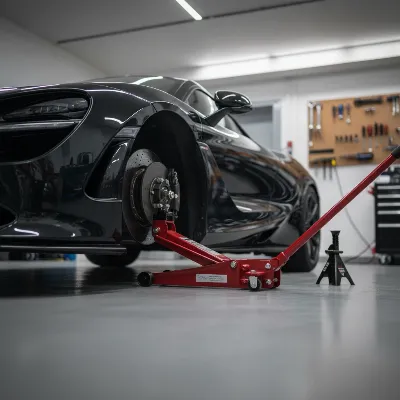 A low-profile floor jack positioned under a lowered sports car's jacking point
Securing
- Always Use Jack Stands: A floor jack is designed for lifting, not for holding. Once the vehicle is at the desired height, immediately place properly rated jack stands under the vehicle’s designated support points. These points are often different from the jacking points, so consult your manual.
- Ensure Proper Placement: Make sure the vehicle’s weight is centered and stable on the jack stands. All four legs of each jack stand should be flat on the ground.
- Stability Check: Once the vehicle is resting on the jack stands, give it a few gentle shoves from different directions to confirm it’s stable and won’t sway or shift.
- “Double-Jack” Safety (Recommended): After placing the car on jack stands, leave the floor jack in place as an additional safety measure, slightly engaged but not bearing the full weight. This provides a backup in case a jack stand fails.
Lowering
- Prepare for Lowering: Ensure all tools and body parts are clear from under the vehicle.
- Raise Slightly, Then Remove Stands: Use the floor jack to slightly raise the vehicle off the jack stands. This takes the pressure off the stands, allowing you to safely remove them one by one.
- Lower Slowly: Carefully turn the release mechanism on the floor jack to slowly lower the vehicle back to the ground. Watch the vehicle as it descends, ensuring it settles evenly. Once fully lowered, remove the floor jack.
Maintaining Your Low-Profile Floor Jack for Longevity
Proper maintenance ensures your floor jack remains a reliable and safe tool for years to come.
- Clean After Use: Wipe down your floor jack after each use to remove dirt, grease, and grime. This prevents corrosion and keeps moving parts free of debris.
- Check Hydraulic Fluid: Periodically inspect the hydraulic fluid level and condition. Refer to your jack’s manual for instructions on how to check and, if necessary, refill or change the hydraulic oil. Low or contaminated fluid can impair performance and cause damage.
- Inspect for Damage: Regularly check all components—wheels, frame, handle, and hydraulic cylinder—for any signs of wear, cracks, leaks, or damage. Address any issues promptly to prevent failure.
- Lubricate Moving Parts: Apply a light lubricant to pivot points and casters to ensure smooth operation.
- Store Properly: Store your floor jack in a clean, dry area, ideally in its lowest position to relieve pressure on the hydraulic system. This prevents rust and extends the life of the seals.
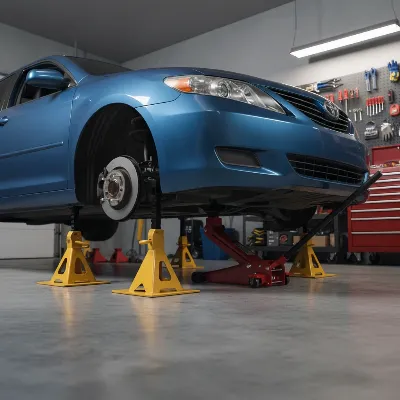 Car safely lifted on jack stands with wheel chocks
Conclusion
Choosing the right floor jack for your lowered car is an investment in both convenience and safety. By prioritizing minimum lift height, appropriate capacity, durable materials, and essential safety features, you can confidently tackle maintenance and repairs. The market offers excellent low-profile options from lightweight aluminum racing jacks to heavy-duty steel variants, each tailored to specific needs and usage patterns. Remember that regardless of the jack you choose, proper usage in conjunction with jack stands and wheel chocks is non-negotiable for a safe working environment. So, are you ready to improve your car care routine with the perfect low-profile floor jack?
Frequently Asked Questions
How low should a floor jack be for a lowered car?
For a lowered car, a floor jack should ideally have a minimum saddle height of 3 to 4 inches or less to ensure it can slide under the vehicle’s low ground clearance without obstruction or damage.
Are aluminum floor jacks strong enough for daily use?
Aluminum floor jacks are generally strong enough for most DIY and mobile use, and often for track days. While they match steel jacks in rated capacity, steel is typically more durable for heavy daily professional shop use due to its greater resistance to wear and tear.
Can I use a regular floor jack on a lowered car with ramps?
While ramps can provide the initial clearance to get a standard jack under a lowered car, it’s often cumbersome and adds an extra step. A dedicated low-profile floor jack is designed to fit directly under most lowered vehicles, offering a more straightforward and convenient solution.
What capacity floor jack do I need for a lowered sedan?
For most lowered sedans, a 2-ton (4,000 lbs) or 3-ton (6,000 lbs) floor jack is usually sufficient. Always consult your car’s owner’s manual for its curb weight and choose a jack with a capacity that can safely lift at least three-quarters of that weight.
What are the most crucial safety accessories when using a floor jack?
The most crucial safety accessories when using a floor jack are jack stands and wheel chocks. Jack stands are essential to securely support the vehicle’s weight once lifted, as a jack alone is not designed for sustained holding. Wheel chocks prevent the vehicle from rolling while being lifted or supported.
Frequently Asked Questions
How low should a floor jack be for a lowered car?
For a lowered car, a floor jack should ideally have a minimum saddle height of 3 to 4 inches or less. This ensures it can slide under the vehicle's low ground clearance without obstruction or damage to the undercarriage.
Are aluminum floor jacks strong enough for daily use?
Aluminum floor jacks are generally strong enough for most DIY and mobile use, and often for track days. While they match steel jacks in rated capacity, steel is typically more durable for heavy daily professional shop use due to its greater resistance to wear and tear.
Can I use a regular floor jack on a lowered car with ramps?
While ramps can provide initial clearance for a standard jack, it's often cumbersome and adds an extra step. A dedicated low-profile floor jack is designed to fit directly under most lowered vehicles, offering a more straightforward and convenient solution without additional equipment.
What capacity floor jack do I need for a lowered sedan?
For most lowered sedans, a 2-ton (4,000 lbs) or 3-ton (6,000 lbs) floor jack is usually sufficient. Always consult your car's owner's manual for its curb weight and choose a jack with a capacity that can safely lift at least three-quarters of that weight for optimal safety.
What are the most crucial safety accessories when using a floor jack?
The most crucial safety accessories when using a floor jack are jack stands and wheel chocks. Jack stands are essential to securely support the vehicle's weight once lifted, as a jack alone is not designed for sustained holding. Wheel chocks prevent the vehicle from rolling while being lifted or supported, adding a critical layer of safety.
Safely Use a Floor Jack for Lowered Cars
Learn the essential steps for safely lifting and securing a lowered vehicle using a low-profile floor jack, jack stands, and wheel chocks.
Park your vehicle on a flat, hard surface and engage the parking brake. Place wheel chocks behind the wheels that will remain on the ground. Consult your vehicle's owner's manual to identify the correct jacking points.
Slide the low-profile floor jack under the designated jacking point, ensuring the saddle makes full and even contact. Slowly pump the handle to raise the vehicle, keeping an eye on stability and balance throughout the lifting process.
Once the vehicle is at the desired height, immediately place properly rated jack stands under the vehicle's designated support points. Ensure the vehicle's weight is centered and stable on the jack stands, with all four legs flat on the ground. For added safety, leave the floor jack slightly engaged as a backup.
Clear all tools and body parts from under the vehicle. Use the floor jack to slightly raise the vehicle off the jack stands, then safely remove the stands. Carefully turn the release mechanism on the floor jack to slowly lower the vehicle back to the ground, ensuring it settles evenly before removing the jack.

Finally, a resource that understands the pain of working on a lowered car! I appreciated the detailed breakdown of crucial buying considerations. I ended up going with the AC Hydraulic DK20HLQ, and the quick lift feature is an absolute game-changer. No more endless pumping to get my Mustang up in the air.
I’ve been struggling to find a reliable jack for my modified Subaru WRX, and this guide was a lifesaver. The recommendation for the Arcan ALJ3T was spot on. Its minimum saddle height of just 3.5 inches is perfect for getting under my car without any scraping. It’s super sturdy and makes oil changes so much easier now.
I was looking for something in the mid-range price point for my sports car. I got the Torin Big Red T83006, and while it does fit under my car, the release valve can be a little finicky sometimes. It’s not a deal-breaker, but it takes a bit of getting used to for a smooth descent. It’s decent for occasional use.
I picked up the Pittsburgh Automotive 3 Ton Low Profile jack after reading about it here. It’s a solid jack for the price, especially for my lowered Civic. My only minor complaint is that it’s a bit heavier than I expected, which makes moving it around the garage a little more work. Still, it gets the job done safely and efficiently.