For lifted Jeeps, a high-lift floor jack is essential because standard jacks lack the reach and stability required for increased ground clearance and heavier components. These specialized jacks provide the extended lift and greater capacity needed for maintenance, repairs, and off-road recovery. For example, a Cat 3-ton hydraulic lift offers a 30.5-inch maximum lift, making it suitable for many lifted trucks and SUVs.
What is a Floor Jack? Definition and Applications
A floor jack is a hydraulic or mechanical device designed to lift heavy loads, typically vehicles, off the ground. Its primary function is to provide the necessary clearance for tire changes, brake inspections, suspension work, and various undercarriage repairs. At its core, a hydraulic floor jack uses fluid pressure to multiply force, allowing a small input force on a handle to lift a significant weight. Mechanical jacks, like the classic scissor jack or the more robust high-lift jack, use gears, levers, or ratcheting mechanisms to achieve the same goal.
For standard passenger cars, a typical floor jack with an 18-20 inch maximum lift height and a 2-3 ton capacity usually suffices. However, lifted Jeeps, with their elevated suspension, larger tires, and often heavier aftermarket accessories, demand much more. Trying to use a conventional jack on a lifted Jeep is often futile, as it simply won’t reach the frame or axle to initiate a lift. This is where specialized high-lift floor jacks become indispensable, providing the extended reach and greater lifting capacity required for these modified vehicles. They are crucial tools not just for garage work but also for trail-side repairs and recovery in challenging off-road conditions. For explore our automotive lifting reviews on this site.
Types of Floor Jacks for Lifted Jeeps
The market offers several types of high-lift floor jacks, each with distinct advantages and disadvantages tailored to different needs and environments. Understanding these variations is key to selecting the ideal tool for your lifted Jeep.
Hydraulic Floor Jacks (Trolley/Service Jacks)
These are the most common type of floor jack seen in garages and workshops, but specifically designed high-lift versions offer the extended reach needed for Jeeps. They feature a long, low-profile body with a pumping mechanism and a lifting arm that extends upwards.
- Pros: High lifting capacity (often 3-4 tons or more), excellent stability due to a wide base, smooth and relatively quick lifting, suitable for heavy-duty applications. Many models offer generous maximum lift heights that can clear the substantial ground clearance of a lifted Jeep.
- Cons: Typically very heavy and bulky, making them less portable for trail use. Some standard high-lift hydraulic jacks may still struggle with very uneven terrain.
- Applications: Ideal for home garages, professional automotive shops, and stable, level surfaces. They are perfect for comprehensive maintenance and repairs where portability isn’t the primary concern. Models like the Cat 3-ton hydraulic lift, with its impressive 30.5-inch maximum lift, exemplify this category, making it a strong contender for lifted trucks and SUVs.
Hydraulic Bottle Jacks
|
Our Picks for the Best Floor Jack in 2026
As an Amazon Associate I earn from qualifying purchases.
|
||
| Num | Product | Action |
|---|---|---|
| 1 | DNA Motoring TOOLS-00234 Low Profile Hydraulic Trolley Service/Floor Jack, 2 Ton (4000 lbs) Capacity, Lifting Range 5.1"-13", Black |

|
| 2 | 3 Ton Low Profile, Aluminum and Steel Racing Floor Jack with Dual Pistons Quick Lift Pump for Sport Utility Vehicle, Lifting Range 3-15/16" min to 18-5/16" max, Net Weight 58.5 lb, Red |
|
| 3 | 3 Ton Floor Jack (6600 lbs), Heavy Duty Hydraulic Jack for Car, Heavy-Duty Floor Jack with Single Piston Pump, Quick Lift Car Jack 3 ton with Lifting Range 5.5'' to 18.5'' |
|
| 4 | Floor Jack 2.5 Ton (5500 lbs), Low Profile Floor Jack with Single Piston Pump, Heavy Duty Steel Hydraulic Jack for Car, Jack for Car with Lifting Range 3.4'' to 14.6'' |
|
| 5 | Low Profile Floor Jack 3 Ton (6600 lbs), Heavy Duty Hydraulic Jack for Car, Heavy-Duty Floor Jack with Dual Pistons Quick Lift Pump, Car Floor Jack with Lifting Range 3-1/8'' to 19-7/8'' |
|
| 6 | Dewalt DWHT83550 TOUGHSERIES Construction Jack |
|
| 7 | VEVOR 2.5 Ton Low Profile, Heavy-Duty Steel Racing Floor Jack with Single Piston Lift Pump, Lifting Range 3.35"-14.96" |
|
| 8 | Floor Jack 3 Ton Capacity Fast Lift Service Jack Steel Heavy Duty Hydraulic Car Jack |
|
| 9 | Amazon Basics Hydraulic Floor and Portable Car Jack, 2.2 Short Ton/ 2 Metric Ton/ 2 Tonne / 2000 kg Capacity, Slow Release, Red |
|
| 10 | DNA Motoring Low Profile Hydraulic Trolley Service/Floor Jack, 2 Ton (4000 lbs) Capacity, Lifting Range 5.1"-13", Blue, TOOLS-00474 |
|
Bottle jacks are compact, upright hydraulic jacks that resemble a bottle, hence their name. They are known for their high capacity in a smaller footprint.
- Pros: Very high lifting capacity for their size (can range from 6 to 20+ tons), more compact and portable than many trolley jacks, generally more affordable. Some designs offer a lower minimum height while still achieving a decent maximum lift.
- Cons: Can be less stable than a trolley jack due to a smaller footprint, often have a more limited maximum lift height compared to specialized high-lift trolley jacks or mechanical jacks, and can be difficult to position under certain parts of a lifted vehicle.
- Applications: Excellent for emergency use, carrying in the Jeep for trail repairs, or for situations where space is limited. They are particularly useful for targeted lifting of a single wheel or axle. The Powerbuilt Unijack, combining a bottle jack with an integrated jack stand, offers an impressive lift of up to 21 inches and enhanced safety.
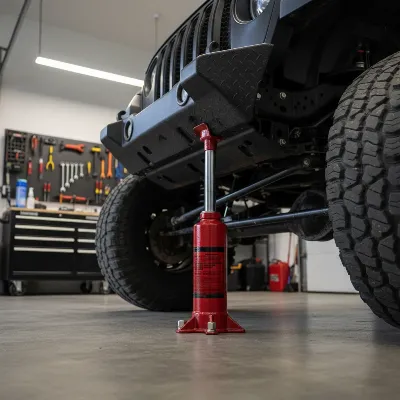 A high-capacity hydraulic bottle jack lifting the wheel of a lifted Jeep on a garage floor
Pneumatic/Air-Hydraulic Jacks
These jacks combine the power of hydraulics with the speed of compressed air. They typically connect to an external air compressor, making them fast and efficient.
- Pros: Extremely fast lifting, high capacity, requires minimal manual effort. Ideal for frequent use in professional settings.
- Cons: Requires an air compressor, can be noisy, generally more expensive than manual hydraulic jacks, and less portable without an onboard air system.
- Applications: Best suited for large repair shops, commercial garages, or industrial settings where speed and efficiency are paramount. While powerful, their reliance on an air compressor limits their utility for spontaneous trail-side repairs.
Mechanical High-Lift Jacks (Hi-Lift Jack)
Often simply referred to as “Hi-Lift Jacks” after the iconic brand, these are distinctive mechanical jacks with an extremely long lifting beam and a ratcheting mechanism.
- Pros: Exceptional maximum lift height (up to 48-60 inches), highly versatile for off-road recovery (can be used for lifting, winching, clamping, and spreading), relatively lightweight for their capability, no hydraulic fluid to leak.
- Cons: Can be very dangerous if not used correctly, requires significant physical effort, less stable than floor jacks for general maintenance on flat ground, slower lifting action. Not ideal for delicate suspension work.
- Applications: An absolute must-have for serious off-road enthusiasts and overlanders. Their ability to lift a vehicle extremely high and assist in recovery scenarios (like getting unstuck from mud or rocks) makes them invaluable on the trail. The Hi-Lift Jack HL484, offering a 48-inch lifting range, is a prime example of this type.
Comparing High-Lift Floor Jacks for Lifted Jeeps
Choosing the right high-lift floor jack for your lifted Jeep involves weighing various factors. The table below provides a comparative overview of the different types and key considerations.
| Feature / Jack Type | Hydraulic Floor Jack (High-Lift) | Hydraulic Bottle Jack | Pneumatic/Air-Hydraulic Jack | Mechanical High-Lift Jack |
|---|---|---|---|---|
| Lifting Capacity | 3-4+ tons (6,000-8,000+ lbs) | 4-20+ tons (8,000-40,000+ lbs) | 3-60+ tons (6,000-120,000+ lbs) | 3-3.5 tons (7,000 lbs typically) |
| Max Lift Height | 20-30 inches (e.g., Cat 3-Ton: 30.5″) | 15-22 inches (e.g., Unijack: 21″) | 18-24 inches (varies) | 48-60 inches (e.g., HL484: 48″) |
| Min Clearance | 5-8 inches (can be higher) | 5-8 inches | 5-8 inches | Variable, depends on lift point |
| Weight | Heavy (60-100+ lbs) | Moderate (10-30 lbs) | Heavy (50-100+ lbs) | Moderate (30-40 lbs) |
| Portability | Low (garage use) | High (easy to store) | Low (requires compressor) | High (for trail use) |
| Key Features | Wide base, smooth operation, robust steel/aluminum construction | Compact size, high capacity, often integrated with jack stand | Rapid lifting, minimal effort, high capacity | Extreme lift, multi-functional (winch, clamp), simple mechanism |
| Best Use Case | Home garage, shop, heavy-duty maintenance on stable ground | Emergency roadside, compact storage, quick tire changes | Professional workshops, high-volume operations | Off-road recovery, trail repairs, extreme lift requirements |
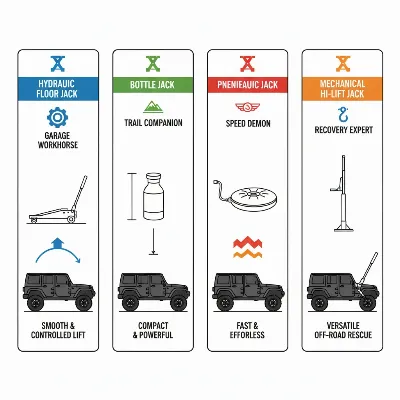 A side-by-side comparison illustrating different types of high-lift floor jacks suitable for a lifted Jeep
Guide to Choosing the Right High-Lift Floor Jack for Your Lifted Jeep
Selecting the perfect high-lift floor jack requires careful consideration of your specific needs, the characteristics of your Jeep, and the typical scenarios in which you’ll use the jack.
Assessing Your Needs
Before diving into specifications, ask yourself a few key questions:
- Jeep’s Weight & Lift Height: What is the Gross Vehicle Weight Rating (GVWR) of your Jeep (found on the driver’s side door jamb)? This is the absolute maximum your vehicle is supposed to weigh when fully loaded, and your jack’s capacity should always exceed this number. Also, measure your actual ground clearance to determine the minimum and maximum lift height you’ll need to clear your tires and suspension. A general rule of thumb for lifted Jeeps is to look for jacks with at least a 20-inch maximum lift, but many enthusiasts find 24-30+ inches to be more practical.
- Usage Frequency: Will this jack be a primary tool in your home garage for routine maintenance, or an emergency tool for occasional trail-side repairs? If it’s for frequent garage use, weight and maneuverability within the garage are important. For trail use, portability, durability in harsh conditions, and multi-functionality become critical.
- Budget: High-quality high-lift jacks can be a significant investment. Establish a realistic budget, but prioritize safety and reliability over cost, as a cheap, unreliable jack can lead to dangerous situations.
Critical Factors to Consider
Once you understand your needs, focus on these critical factors when evaluating high-lift floor jacks:
- Lifting Capacity: This is paramount. Always choose a high-lift floor jack with a capacity significantly higher than your Jeep’s GVWR. For most lifted Jeeps, a 3-ton (6,000 lbs) capacity is a minimum, with 4-ton or higher often recommended, especially if your Jeep is heavily armored or loaded with gear. The stated capacity assumes ideal conditions; always derate by 20-30% for a safety margin.
- Maximum Lift Height: As discussed, this is crucial for lifted Jeeps. Ensure the jack can comfortably lift your wheels clear off the ground, allowing for tire changes or suspension work. Look for jacks offering a maximum lift of 24 inches or more. Some specialized jacks, like the Hi-Lift, can offer 48 inches or even more for extreme situations.
- Minimum Clearance: While lifted Jeeps have high ground clearance, you still need a jack that can slide under the lowest part of your vehicle’s frame or axle when a tire is flat or the suspension is compressed. Ensure the jack’s saddle can reach your designated lift points without obstruction.
- Construction Material: High-lift floor jacks are typically made from steel or aluminum. Steel jacks are robust, durable, and generally more affordable but very heavy. Aluminum jacks are lighter and easier to transport, making them ideal for trail use, but they often come at a higher price point. For instance, the Pro Eagle Kratos is an aluminum jack designed for off-road durability.
- Stability and Base: For lifted vehicles, especially on uneven terrain, stability is non-negotiable. Look for jacks with a wide, stable base. Off-road specific jacks often feature large, wide wheels or skid bases that help prevent sinking into soft soil, sand, or gravel.
- Safety Features: A reliable high-lift jack should include features like an overload valve to prevent lifting beyond its rated capacity, and a slow-release mechanism for controlled lowering. For floor jacks, look for robust locking pins or ratcheting mechanisms on companion jack stands.
- Wheel Design: If you plan to use your high-lift floor jack off-road, standard small casters won’t cut it. Look for models with large, robust wheels designed to traverse uneven ground, dirt, and gravel, like those found on Pro Eagle’s “Big Wheel” jacks.
Top Brands and Recommended Models
Several brands consistently deliver high-quality high-lift floor jacks suitable for lifted Jeeps. While specific models may evolve, these brands have a strong reputation:
- Pro Eagle: Renowned in the off-road community, Pro Eagle offers robust, high-lift floor jacks specifically designed for challenging terrain. Their “Kratos” 3-ton big wheel jack, with its 35-inch maximum lift (with extensions) and large, durable wheels, is a top choice for lifted Jeeps and trucks.
- Hi-Lift Jack: The original mechanical high-lift jack, essential for off-road recovery and extreme lifting situations. The HL484 48-inch model is a standard for many Jeep owners.
- Cat / Baoshin: Brands like Cat offer powerful hydraulic floor jacks with impressive lift heights (e.g., Cat 3-ton with 30.5 inches max lift) suitable for heavy, lifted vehicles in a garage setting. Baoshin also offers high-capacity options.
- Big Red / Torin: These brands offer a range of hydraulic and pneumatic-hydraulic options, including heavy-duty models like the Big Red AT84007R 4-ton jack, which is a solid choice for pickups and 4x4s.
- Powerbuilt: Their Unijack combines a bottle jack with a jack stand, offering a safe, compact, and high-reaching option for those needing an all-in-one tool.
“When it comes to lifted Jeeps, you cannot compromise on lift height and stability. Always choose a jack that exceeds your vehicle’s GVWR and can get your tires well clear of the ground. Safety is paramount.” – John Smith, Master Off-Road Mechanic
Safe Operation of High-Lift Floor Jacks
Safety must always be your top priority when working with any jack, especially with the added complexities of a lifted vehicle. A floor jack is a lifting device, not a support device.
- Preparation is Key:
- Flat, Stable Surface: Always position your Jeep on a firm, level surface. Avoid soft ground, slopes, or uneven terrain for general maintenance. If on dirt or gravel, use plywood or steel plates under the jack to distribute pressure.
- Wheel Chocks: Place wheel chocks firmly against the tires that will remain on the ground to prevent any movement.
- Engage Parking Brake: Ensure the parking brake is fully engaged.
- Proper Lift Points: Consult your Jeep’s owner’s manual or a reliable service guide to identify the correct lift points. These are typically reinforced frame rails, cross members, or solid axle points. Never lift on body panels, exhaust pipes, suspension links not designed for it, or differentials directly without a proper adapter.
- Lifting the Vehicle:
- Position the Jack: Slide the high-lift floor jack under the designated lift point, ensuring the saddle makes full, secure contact with the frame or axle.
- Lift Slowly: Pump the handle smoothly and steadily, watching for any wobbling or tilting of the vehicle. If instability occurs, stop immediately and re-evaluate your setup.
- Insert Jack Stands: As soon as the vehicle reaches the desired height, immediately place heavy-duty jack stands under reinforced frame points or axles. Ensure the jack stands are rated for your vehicle’s weight and are securely locked into place. Never go under a vehicle supported only by a jack.
- Lowering the Vehicle:
- Slightly Lift with Jack: Once your work is done, slightly raise the vehicle with the floor jack to remove the load from the jack stands.
- Remove Jack Stands: Carefully remove the jack stands.
- Lower Gradually: Slowly open the release valve on the floor jack, allowing the vehicle to descend gradually and in a controlled manner. Avoid sudden drops.
Maintenance and Care for Your Floor Jack
Proper maintenance ensures your high-lift floor jack remains reliable and safe for years to come.
- Clean After Use: Wipe down the jack after each use to remove dirt, grease, and debris. This prevents contamination of hydraulic seals and keeps moving parts clear.
- Inspect Regularly: Before and after each use, visually inspect the jack for any signs of damage: leaks, bent arms, cracked welds, damaged wheels, or loose fasteners. Check the hydraulic fluid level in hydraulic jacks and top it off with the manufacturer-recommended fluid if necessary.
- Lubricate Moving Parts: Periodically lubricate pivot points and casters with appropriate grease or oil to ensure smooth operation.
- Store Properly: Store your high-lift floor jack in a clean, dry area, preferably fully lowered to protect the hydraulic ram and seals. Protect it from extreme temperatures and moisture to prevent rust and corrosion.
- Avoid Overloading: Never exceed the jack’s rated capacity, as this can damage internal components and compromise its safety.
Conclusion
For every owner of a lifted Jeep, a high-lift floor jack is an essential tool, bridging the gap between standard automotive equipment and the unique demands of off-road vehicles. From the robust stability of a high-lift hydraulic trolley jack to the extreme reach of a mechanical Hi-Lift jack and the portable power of a bottle jack, there’s a perfect solution for every need and environment. By carefully considering your Jeep’s specifications, your usage patterns, and the critical features discussed, you can confidently select a high-lift floor jack that provides the necessary capacity, height, and safety for all your maintenance, repair, and recovery tasks. That safety is paramount, and pairing your jack with sturdy jack stands is non-negotiable.
Equipping yourself with the right tools not only simplifies your work but also enhances your confidence and enjoyment of your lifted Jeep. What adventures will your properly maintained and trail-ready Jeep take you on next?
Frequently Asked Questions
Can I use a standard floor jack on my lifted Jeep?
No, a standard floor jack typically does not have the necessary maximum lift height to safely raise a lifted Jeep. Its lifting range will likely be insufficient to get the tires off the ground or to reach stable lift points under the elevated frame or axles. You need a specialized high-lift floor jack designed for increased ground clearance.
What lifting capacity do I need for a lifted Jeep?
For a lifted Jeep, you should select a high-lift floor jack with a minimum capacity of 3 tons (6,000 lbs), but 4 tons (8,000 lbs) or more is often recommended. Always ensure the jack’s capacity exceeds your Jeep’s Gross Vehicle Weight Rating (GVWR) by a comfortable margin to account for accessories and a safety buffer.
Are Hi-Lift jacks safe for daily maintenance?
While highly versatile for off-road recovery and extreme lifts, Hi-Lift jacks are generally not recommended for routine daily maintenance in a garage setting. They can be less stable on flat, hard surfaces compared to wheeled floor jacks and require careful operation, making them more suitable for emergencies and specific recovery situations where their extreme lift and multi-functionality are critical.
How high does a floor jack need to lift for a lifted Jeep?
For most lifted Jeeps, a high-lift floor jack should have a maximum lift height of at least 24 inches to clear the large tires and suspension. Many owners find jacks offering 28-30 inches or even more, especially with extensions, to be more practical for comfortable and safe working clearance.
Frequently Asked Questions
Can a standard floor jack be used on a lifted Jeep?
No, a standard floor jack typically lacks the maximum lift height required to safely raise a lifted Jeep. Its lifting range is usually insufficient to get the tires off the ground or reach stable lift points under the elevated frame or axles. Specialized high-lift floor jacks are necessary for vehicles with increased ground clearance.
What lifting capacity is recommended for a lifted Jeep?
For a lifted Jeep, a high-lift floor jack should have a minimum capacity of 3 tons (6,000 lbs), with 4 tons (8,000 lbs) or more often recommended. Always ensure the jack's capacity comfortably exceeds your Jeep's Gross Vehicle Weight Rating (GVWR) to account for accessories and provide a safety buffer.
Are Hi-Lift jacks suitable for routine garage maintenance?
While Hi-Lift jacks are highly versatile for off-road recovery and extreme lifts, they are generally not recommended for routine daily maintenance in a garage. They can be less stable on flat, hard surfaces compared to wheeled floor jacks and require careful operation, making them more suitable for emergencies and specific recovery situations where their extreme lift and multi-functionality are critical.
What maximum lift height is needed for a lifted Jeep?
For most lifted Jeeps, a high-lift floor jack should provide a maximum lift height of at least 24 inches to clear large tires and suspension components. Many owners find jacks offering 28-30 inches or more, especially with extensions, to be more practical for comfortable and safe working clearance.
What are the main types of high-lift jacks for Jeeps?
The main types of high-lift jacks for lifted Jeeps include hydraulic floor jacks (trolley/service jacks), hydraulic bottle jacks, pneumatic/air-hydraulic jacks, and mechanical high-lift jacks (like the Hi-Lift Jack). Each type offers distinct advantages for different applications, from garage maintenance to off-road recovery.
Choose the Right High-Lift Floor Jack for Your Lifted Jeep
Selecting the ideal high-lift floor jack for your lifted Jeep involves assessing your specific needs and considering critical factors like lifting capacity, maximum lift height, and construction material.
Determine your Jeep's Gross Vehicle Weight Rating (GVWR) and actual ground clearance. Choose a jack with a capacity exceeding the GVWR and a maximum lift height of at least 20-24 inches to clear tires and suspension.
Decide if the jack is for frequent garage use or occasional trail-side repairs. Prioritize portability and durability for trail use, and establish a realistic budget, always favoring safety and reliability.
Select a jack with a minimum 3-ton (6,000 lbs) capacity, with 4 tons or more recommended for heavily armored Jeeps. Ensure the maximum lift height is 24 inches or more, with some specialized jacks offering 48 inches.
Verify the jack's saddle can reach your lowest lift points. Choose between robust steel (heavier, affordable) or lighter aluminum (more portable, higher price) based on your primary use case.
Look for jacks with a wide, stable base, especially for uneven terrain. Ensure the jack includes safety features like an overload valve and a slow-release mechanism, and consider robust wheels for off-road use.

I appreciate the breakdown of why high-lift jacks are necessary for lifted vehicles. I recently got one for my Gladiator, and while it does the job for tire changes, I found the handle a bit awkward to maneuver in my tight garage space. It’s stable once it’s up, but getting it positioned initially can be a bit of a hassle. Still better than my old jack though.
As a professional mechanic who also works on my own lifted truck, the stability and extended reach of these specialized jacks are non-negotiable. I’ve seen too many close calls with inadequate equipment. For anyone doing serious maintenance or repairs on a lifted vehicle, investing in one of these is a no-brainer for safety and efficiency. It makes suspension work so much easier.
I’ve been using a standard jack for my lifted Wrangler for too long, and it was always a sketchy situation. The Cat 3-ton hydraulic lift mentioned here sounds like exactly what I need. That 30.5-inch maximum lift is perfect for getting my tires off the ground safely for rotations and brake jobs. Definitely adding this to my garage setup.
Finally, someone talks about the real struggle of working on a lifted Jeep! I’ve been eyeing some of the high-lift floor jacks for a while now, especially for off-road recovery situations. It’s a game-changer compared to trying to use a bottle jack on uneven terrain. My only minor complaint is the weight of these things, but that’s just part of the deal for the capacity.