For DIY and professional mechanics, a reliable floor jack is essential for safe vehicle maintenance, and several quality options are available for under $100. These budget-friendly jacks, primarily hydraulic trolley jacks, offer sufficient lifting capacity (typically 2 to 3 tons) for routine tasks like oil changes, tire rotations, and brake repairs without compromising safety. Key models include the Pro-Lift F-767 Low Profile Floor Jack and the Torin Big Red T820014S Hydraulic Trolley Jack, both known for their value and performance within this price range.
What is a Floor Jack?
A floor jack is a mechanical device specifically engineered to lift vehicles or heavy objects off the ground, providing crucial clearance for maintenance, repairs, or inspections. Most commonly, these tools operate using a hydraulic system, which converts a small amount of force applied to a pump handle into a much larger lifting force. This mechanism allows you to raise thousands of pounds with relative ease, making tasks like changing a flat tire or rotating your wheels manageable.
Floor jacks are indispensable for various automotive applications, including:
- Tire Changes: Quickly and safely lifts a wheel off the ground.
- Brake Service: Provides access to calipers, rotors, and pads for inspection or replacement.
- Oil Changes: Elevates the vehicle to access the drain plug and oil filter.
- Undercarriage Inspections: Offers clearance to check suspension components, exhaust systems, or frame integrity.
- Detailing and Cleaning: Lifts the vehicle for better access to wheel wells and lower body panels.
Types of Floor Jacks on the Market
Understanding the different types of floor jacks is crucial, as each offers unique advantages and is suited for specific tasks and user preferences.
Hydraulic Floor Jack (Trolley Jack)
Hydraulic floor jacks, often referred to as trolley jacks, are the most popular choice for both professional mechanics and home DIYers due to their impressive lifting power and ease of use. They employ hydraulic fluid pressure to raise a robust lifting arm.
- Pros: High lifting capacity (commonly 2 to 3.5 tons), smooth and controlled lifting/lowering, generally stable with a wide base, and many models feature a low-profile design to fit under vehicles with minimal ground clearance.
- Cons: Can be bulky and heavy, especially steel models, requiring more storage space and effort to move around. While budget options exist, high-end models can exceed the $100 mark.
- Applications: Ideal for general automotive repair, tire rotations, brake jobs, and situations requiring reliable, consistent lifting power in a garage or workshop setting.
Pneumatic Floor Jack
Pneumatic floor jacks utilize compressed air to lift a vehicle, offering rapid and effortless operation. They are typically found in professional settings where air compressors are readily available.
- Pros: Extremely fast lifting speeds, minimal manual effort required, high efficiency for repetitive tasks.
- Cons: Requires an external air compressor for operation, which adds to the overall cost and limits portability. Can be noisy, and most robust pneumatic jacks are priced significantly above $100.
- Applications: Best suited for busy auto repair shops, commercial garages, or assembly lines where speed and efficiency are paramount. Less practical for typical home garage use due to compressor requirement.
Mechanical Floor Jack (Scissor Jack)
|
Our Picks for the Best Floor Jack in 2026
As an Amazon Associate I earn from qualifying purchases.
|
||
| Num | Product | Action |
|---|---|---|
| 1 | DNA Motoring TOOLS-00234 Low Profile Hydraulic Trolley Service/Floor Jack, 2 Ton (4000 lbs) Capacity, Lifting Range 5.1"-13", Black |

|
| 2 | Floor Jack 2.5 Ton (5500 lbs), Low Profile Floor Jack with Single Piston Pump, Heavy Duty Steel Hydraulic Jack for Car, Jack for Car with Lifting Range 3.4'' to 14.6'' |
|
| 3 | 3 Ton Low Profile, Aluminum and Steel Racing Floor Jack with Dual Pistons Quick Lift Pump for Sport Utility Vehicle, Lifting Range 3-15/16" min to 18-5/16" max, Net Weight 58.5 lb, Red |
|
| 4 | Floor Jack 3 Ton Capacity Fast Lift Service Jack Steel Heavy Duty Hydraulic Car Jack |
|
| 5 | Low Profile Floor Jack 3 Ton (6600 lbs), Heavy Duty Hydraulic Jack for Car, Heavy-Duty Floor Jack with Dual Pistons Quick Lift Pump, Car Floor Jack with Lifting Range 3-1/8'' to 19-7/8'' |
|
| 6 | VEVOR 2.5 Ton Low Profile, Heavy-Duty Steel Racing Floor Jack with Single Piston Lift Pump, Lifting Range 3.35"-14.96" |
|
| 7 | 3 Ton Floor Jack (6600 lbs), Heavy Duty Hydraulic Jack for Car, Heavy-Duty Floor Jack with Single Piston Pump, Quick Lift Car Jack 3 ton with Lifting Range 5.5'' to 18.5'' |
|
| 8 | Dewalt DWHT83550 TOUGHSERIES Construction Jack |
|
| 9 | DNA Motoring Low Profile Hydraulic Trolley Service/Floor Jack, 2 Ton (4000 lbs) Capacity, Lifting Range 5.1"-13", Blue, TOOLS-00474 |
|
| 10 | Amazon Basics Hydraulic Floor and Portable Car Jack, 2.2 Short Ton/ 2 Metric Ton/ 2 Tonne / 2000 kg Capacity, Slow Release, Red |
|
Often included as standard equipment in a vehicle’s emergency kit, the mechanical or scissor jack operates via a screw mechanism that expands and contracts to lift the vehicle.
- Pros: Extremely compact, lightweight, and highly affordable, making them easy to store in a trunk for emergencies.
- Cons: Limited lifting capacity (typically 1.5 to 2 tons), requires significant manual effort and time to operate, less stable compared to other types, and offers a restricted lift height.
- Applications: Primarily intended for emergency roadside tire changes or very light, infrequent lifting tasks where portability and cost are the main concerns. Not recommended for extensive under-vehicle work.
Bottle Jack
Bottle jacks are characterized by their vertical, cylindrical design, resembling a bottle. They use a hydraulic piston to lift directly upwards.
- Pros: Remarkably high lifting capacity for their compact size (often 2 to 20 tons), making them suitable for heavier vehicles. Relatively affordable.
- Cons: Shorter maximum lift height compared to trolley jacks, can be less stable on uneven surfaces, and often requires a higher minimum clearance to position under a vehicle, which might be an issue for low-profile cars.
- Applications: Excellent for lifting trucks, SUVs, RVs, and even some heavy machinery where vertical lift and high capacity are needed, provided the vehicle has sufficient ground clearance.
Comparing Floor Jack Types
Choosing the right floor jack involves balancing capacity, lift range, portability, and your specific budget. Here’s a comparative overview to help you decide:
| Criteria | Hydraulic Floor Jack (Trolley) | Scissor Jack | Bottle Jack | Pneumatic Floor Jack |
|---|---|---|---|---|
| Lifting Capacity | 2 – 3.5 tons (4,000-7,000 lbs) | 1.5 – 2 tons (3,000-4,000 lbs) | 2 – 20 tons (4,000-40,000 lbs) | 2 – 22 tons (4,000-44,000 lbs) |
| Min. Lift Height | Often low (3-5 inches) | Varies, can be 4-6 inches | Often higher (6-9 inches) | Varies (often low profile available) |
| Max. Lift Height | Good range (14-22 inches) | Limited (10-15 inches) | Shorter range (10-20 inches) | Excellent range (up to 25 inches or more) |
| Weight/Portability | Moderate to heavy; wheeled for mobility | Very lightweight; highly portable | Lightweight for capacity; moderate portability | Moderate to heavy; often wheeled |
| Typical Price | $70 – $300+ | $20 – $50 | $40 – $200+ | $90 – $2000+ |
| Durability | Good (steel or aluminum) | Fair (basic steel) | Excellent (heavy-duty steel) | Excellent (heavy-duty components) |
| Key Feature | Smooth, controlled, versatile | Compact, emergency use | High capacity in small footprint | Fast, effortless, high-volume |
| Requires Air | No | No | No | Yes |
Choosing the Right Budget Floor Jack
Selecting a floor jack that meets your needs and stays within a $100 budget requires careful consideration of several factors.
Determine Your Usage Needs
First, assess what kind of work you’ll be doing and with what vehicle:
- Vehicle Type and Weight: A compact sedan typically weighs 3,000-4,000 lbs, requiring at least a 2-ton (4,000 lb) jack. SUVs and light trucks, often weighing 4,500-6,000 lbs, will need a 3-ton or higher capacity jack. Always check your vehicle’s Gross Vehicle Weight Rating (GVWR) or curb weight.
- Frequency of Use: For occasional tire changes, a basic scissor or smaller hydraulic jack might suffice. For regular DIY maintenance, a more robust hydraulic trolley jack will be a better investment.
- Ground Clearance: If you own a lowered sports car or a vehicle with minimal ground clearance, a low-profile floor jack is a non-negotiable feature.
- Storage Space: Consider how much space you have available. Scissor jacks are tiny, while even budget trolley jacks can be cumbersome.
Key Factors When Choosing
Once you understand your needs, focus on these critical specifications:
- Lifting Capacity (Tonnage): This is paramount for safety. Ensure the jack’s maximum weight capacity exceeds the heaviest weight you intend to lift. A general rule of thumb is to choose a jack capable of lifting at least three-quarters of your vehicle’s total weight, as you typically only lift one end at a time.
- Lift Height (Minimum and Maximum): The minimum lift height is important for getting under low-clearance vehicles. The maximum lift height determines how high you can raise the vehicle, impacting your working room.
- Material and Build Quality: Most budget jacks are made of steel, offering good durability at a lower cost, though they are heavier. Aluminum jacks are lighter and more portable but typically fall outside the sub-$100 price range. Look for sturdy construction and stable wheels.
- Brand and Reliability: While under $100, some brands consistently offer better value and performance. Look for products with good user reviews and safety certifications (like ASME PALD).
- Safety Features: Essential safety features include an overload protection valve to prevent lifting beyond capacity and a controlled release valve for smooth, safe lowering. A wide base and stable casters also contribute to overall safety.
Top Budget Floor Jack Recommendations (Under $100 in 2026)
Finding a quality floor jack under $100 in 2026 requires smart shopping, often leveraging sales and specific brands known for value. Here are some standout contenders:
- Pro-Lift F-767 Low Profile Floor Jack: This 2-ton hydraulic jack is frequently cited for its robust build and low-profile design, making it suitable for a wide range of vehicles, including those with limited clearance. Its price often hovers just under or around the $100 mark, offering excellent value.
- Torin Big Red T820014S Hydraulic Trolley Jack: A highly portable 2-ton hydraulic jack that often retails well under $80. It’s a solid choice for occasional use and easy transport, weighing less than 30 pounds.
- ROGTZ Electric Car Floor Jack: For convenience, this 3-ton electric jack, often found around $60, offers push-button power lifting. While not a traditional hydraulic trolley jack, its ease of use for quick lifts and tire changes makes it a compelling budget option for many.
- Harbor Freight Pittsburgh 2 or 3-ton Steel Floor Jacks: Harbor Freight is renowned for its competitive pricing, and their Pittsburgh line often has 2-ton and 3-ton steel hydraulic floor jacks available for under $100, especially with coupons. These are often basic but reliable workhorses for a home garage.
- Torin Big Red Scissor Jack: If your budget is extremely tight, or you need a compact emergency jack, the Torin Big Red scissor jack can be found for $20-$30. It’s a reliable choice for small cars and infrequent emergency use, but its limitations.
Prices for these models can fluctuate, so always check current deals and availability from retailers like Amazon, Walmart, Harbor Freight, and other automotive supply stores.
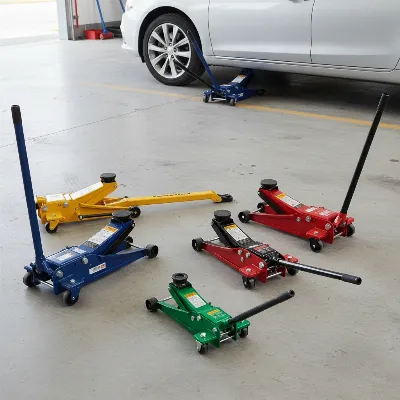 A selection of affordable hydraulic floor jacks under $100 in a clean garage setting with a car partially lifted.
How to Use a Floor Jack Safely
Safety is paramount when working with any lifting equipment. Improper use of a floor jack can lead to serious injury or damage to your vehicle. Always follow these essential safety guidelines:
- Level and Firm Surface: Always position your vehicle on a flat, solid, non-slip surface like concrete or asphalt. Never use a jack on inclines, soft ground, gravel, or dirt, as it can cause the jack to shift or sink.
- Engage Parking Brake and Wheel Chocks: Before lifting, ensure your vehicle’s parking brake is fully engaged. For added stability, place wheel chocks behind the wheels that remain on the ground (e.g., if lifting the front, chock the rear wheels).
- Locate Proper Jack Points: Consult your vehicle’s owner’s manual to identify the designated jack points. These are reinforced areas on the vehicle’s frame designed to safely support its weight. Using incorrect points can damage the vehicle’s undercarriage or lead to instability.
- Position the Jack Correctly: Slide the jack under the designated jack point, ensuring the saddle (the part that contacts the vehicle) is centered and making full contact.
- Lift Smoothly and Gradually: Pump the jack handle steadily to raise the vehicle. Avoid jerky movements. Raise the vehicle only high enough to perform your task comfortably.
- ALWAYS Use Jack Stands: This step cannot be overstressed. A floor jack is designed for lifting a vehicle, not supporting it for extended periods. Once the vehicle is at the desired height, immediately place properly rated jack stands beneath the vehicle’s frame or designated support points. Slowly lower the jack until the vehicle rests securely on the jack stands. Never work under a vehicle supported only by a jack.
- Lower Carefully: Once your work is complete and all tools are clear, raise the jack slightly to relieve pressure from the jack stands, remove the stands, and then slowly lower the vehicle using the jack’s release valve.
“A floor jack is your initial lift, but jack stands are your life support. Never, ever get under a vehicle without proper jack stand support.”
Maintaining Your Floor Jack
Proper maintenance is key to ensuring your budget floor jack remains reliable and safe for years to come. Neglecting maintenance can lead to premature wear, reduced performance, and even safety hazards.
- Regular Cleaning: After each use, wipe down your floor jack with a clean, dry cloth to remove dirt, dust, and any oil or grease buildup. Pay special attention to the wheels, lifting arm, and release valve mechanism. Accumulated debris can hinder smooth operation and lead to corrosion.
- Lubrication: Periodically lubricate all moving parts, such as the pump mechanism, pistons, and pivot points, with a high-quality, non-greasy lubricant suitable for hydraulic systems. This reduces friction and ensures smooth operation.
- Check Hydraulic Fluid Levels: For hydraulic jacks, regularly inspect the hydraulic fluid level. Low fluid can result in poor lifting performance or a “spongy” feel. Consult your owner’s manual for instructions on how to check and top off the fluid. If the jack feels weak or doesn’t lift smoothly, it might have air trapped in the system, which can be bled out following manufacturer guidelines.
- Inspect for Damage and Leaks: Before each use, quickly check for any signs of physical damage like cracks, dents, or bent components. For hydraulic jacks, look for any fluid leaks around the pump or seals. Address any issues promptly.
- Proper Storage: Store your floor jack in a clean, dry environment, ideally in your garage or workshop. Avoid leaving it exposed to direct sunlight, moisture, or extreme temperatures, as these can accelerate rust and degrade hydraulic components. Store the jack in its fully lowered, neutral position, with no load on it.
A well-maintained floor jack is a safe floor jack, and it will serve you faithfully through countless DIY projects.
Conclusion
Investing in a reliable budget floor jack doesn’t mean sacrificing quality or safety. With the right knowledge and careful consideration, you can find an excellent tool under $100 that will empower your automotive endeavors for years to come. Prioritize capacity, lift range, and essential safety features, and always to pair your jack with sturdy jack stands for ultimate security. Regular maintenance—cleaning, lubrication, and fluid checks—will ensure your chosen jack performs optimally and lasts longer. By following this guide, you’re well-equipped to make an informed decision and confidently tackle your next vehicle project.
What essential feature do you look for most in an affordable floor jack for your home garage?
Frequently Asked Questions
Frequently Asked Questions
Can a 2-ton floor jack safely lift an SUV?
A 2-ton (4,000 lb) floor jack is generally suitable for lifting most sedans and smaller SUVs, as you typically only lift one end of the vehicle at a time. However, for larger, heavier SUVs or trucks, a 3-ton or higher capacity jack is recommended for added safety and stability. Always check your vehicle's curb weight and ensure the jack's capacity exceeds it.
What is the main difference between a floor jack and a bottle jack?
A floor jack (or trolley jack) features a low-profile, wheeled design that rolls under a vehicle and uses a horizontal hydraulic cylinder for lifting. Bottle jacks are compact, vertical, and use a vertical hydraulic piston, offering very high capacity for their size but often requiring more ground clearance and having a shorter lift range.
Do budget floor jacks typically include jack stands?
No, floor jacks are typically sold separately from jack stands, especially at the budget price point under $100. Some retailers might offer bundles, but it's essential to check the product description carefully. Jack stands are a critical safety component and should always be used when working under a lifted vehicle.
How often should I inspect the hydraulic fluid in my floor jack?
It is good practice to check the hydraulic fluid level in your floor jack annually or whenever you notice a decrease in lifting performance, a spongy feel, or signs of leaks. Consult your jack's owner's manual for the specific procedure and recommended fluid type to ensure optimal operation.
Is an electric floor jack a good value for under $100?
An electric floor jack under $100, such as the ROGTZ 3-ton model, can be a convenient option for quick, light-duty tasks like emergency tire changes, as it minimizes manual effort. However, they may not offer the same robust build or lift range as a traditional hydraulic trolley jack in the same price bracket. Assess your primary use case and prioritize safety features and stability.
How to Use a Floor Jack Safely
Learn the essential steps for safely lifting and supporting a vehicle using a floor jack and jack stands to prevent injury and vehicle damage.
Always position your vehicle on a flat, solid, non-slip surface like concrete or asphalt. Engage the parking brake and place wheel chocks behind the wheels that remain on the ground for added stability.
Consult your vehicle's owner's manual to identify the designated jack points, which are reinforced areas on the frame. Slide the floor jack under the designated point, ensuring the saddle is centered and making full contact.
Pump the jack handle steadily to raise the vehicle smoothly and gradually to the desired height. Immediately place properly rated jack stands beneath the vehicle's frame or designated support points. Slowly lower the jack until the vehicle rests securely on the jack stands.
Once your work is complete and all tools are clear, raise the jack slightly to relieve pressure from the jack stands. Remove the jack stands, then slowly lower the vehicle using the jack's release valve until it is fully on the ground.

I picked up the Torin Big Red T820014S after reading about it, and it’s been a game-changer for my garage. I do a lot of my own oil changes and tire rotations, and this jack handles my sedan and even my small SUV with no problem. For under $100, the lifting capacity is really impressive and it feels super stable.
This was super helpful in finding a reliable floor jack that wouldn’t break the bank. I needed something for routine maintenance on my family’s cars, and the 2-ton capacity is perfect. It’s made my DIY projects so much safer and easier, especially when I’m doing suspension work.
Got one of the hydraulic trolley jacks mentioned, and while it works for basic stuff like tire changes, I wish it had a quicker lift. It takes quite a few pumps to get my truck up to a decent height. For the price, it’s okay, but next time I might splurge a bit more for something faster.
I’ve been using the Pro-Lift F-767 Low Profile Floor Jack for a few weeks now, and it’s solid. It gets under my lowered car easily, which was my main concern. My only minor complaint is that the handle could be a little longer for better leverage, but it still gets the job done for brake repairs without much fuss.