Lifting a vehicle, whether for a quick tire change or more extensive maintenance, is a common task for any car owner or technician. However, when faced with soft surfaces like dirt, gravel, or even hot asphalt, the reliable Floor Jack can quickly become a safety hazard. Designed primarily for hard, flat surfaces, a Floor Jack’s concentrated pressure on soft ground can cause it to sink, leading to instability, potential vehicle damage, and serious personal injury. This guide offers expert advice and practical, proven techniques to ensure your Floor Jack remains stable and secure, even on challenging terrains, safeguarding both your vehicle and your well-being.
What is a Floor Jack and Why Does it Sink on Soft Ground?
A Floor Jack is a hydraulic or mechanical device used to lift heavy objects, most commonly vehicles. It operates by applying force to a small area, generating immense lifting power to raise one section of a car or truck off the ground. While incredibly efficient on solid surfaces like concrete, this very principle of concentrated force becomes its downfall on softer terrain. When the narrow contact points of the jack’s wheels or base press down on loose dirt, gravel, or grass, the ground cannot support the intense pressure. Instead of lifting the vehicle, the jack begins to displace the soft material beneath it, causing it to sink and lose its crucial stability. This uneven sinking can lead to the jack tilting, shifting, or even collapsing, creating a dangerous situation.
Types of Stabilizing Materials for Soft Ground
To counteract the sinking effect, the primary goal is to increase the surface area over which the jack’s weight is distributed. This reduces the pressure per square inch on the ground, preventing it from yielding. Several materials can be effectively used as a stable base for your Floor Jack.
Plywood and Solid Wood Planks
- Advantages: Wood is a universally accessible and cost-effective solution. Plywood, especially ¾-inch thick or more, provides excellent load distribution. Larger pieces (e.g., 12×12 inches or more) or multiple layers can further enhance stability. Solid wood planks, such as 2x10s or 4×6 posts, offer even greater strength and are less prone to splintering under extreme pressure, making them ideal for heavier vehicles.
- Disadvantages: Wood can absorb moisture over time, potentially weakening it or making it heavier. While durable, it can still splinter or deform under very heavy loads or sharp points.
- Application: Ideal for general automotive work, roadside emergencies on soft shoulders, and temporary lifting tasks on grass or dirt. Always ensure the wood piece is large enough to accommodate the entire footprint of the jack, including its wheels for rolling models.
Steel Plates
- Advantages: Steel plates offer exceptional durability and load distribution in a relatively thin profile. They are highly resistant to deformation, splintering, and moisture. A 1/8-inch thick steel plate or greater can provide a robust and long-lasting solution.
- Disadvantages: Steel plates are significantly heavier than wood counterparts, making them less portable. They can also be more expensive and may require anti-slip surfacing if used on very slick surfaces.
- Application: Best suited for professional garages that frequently work on varied terrains, heavy-duty applications, or when a permanent, highly stable solution is required.
Concrete or Masonry Blocks
- Advantages: Solid concrete or masonry blocks, particularly those that are 4 inches thick or more (like concrete cap stones), provide an extremely sturdy and unyielding base. They are excellent for handling significant weight.
- Disadvantages: These blocks are very heavy and cumbersome to transport and position. Crucially, common pavers or thin concrete blocks are brittle and can shatter under concentrated pressure, posing a severe hazard. Only solid, thick, and reinforced blocks should ever be considered.
- Application: Often used in more permanent settings, such as under sheds or when lifting extremely heavy structures like parts of a house, where long-term, unmoving support is paramount.
Specialized Plastic Pads
- Advantages: Designed specifically for stabilizing jacks, these lightweight, durable plastic pads are convenient and weather-resistant. Many are stackable and come with carrying bags, making them highly portable.
- Disadvantages: While convenient, they often have a lower weight capacity compared to thick wood or steel and might be smaller in surface area.
- Application: Popular among RV owners for stabilizing leveling jacks and suitable for lighter vehicle maintenance or roadside assistance where portability is key.
Comparison of Stabilizing Materials
To help you choose the best option for your needs, here’s a quick comparison of common stabilizing materials:
| Feature | Plywood / Solid Wood Planks | Steel Plates | Concrete / Masonry Blocks (Thick) | Specialized Plastic Pads |
|---|---|---|---|---|
| Load Capacity | Good to Very Good (depends on thickness/type) | Excellent | Excellent | Fair to Good (varies by product) |
| Durability | Moderate (can splinter, absorb moisture) | Excellent (corrosion-resistant if treated) | Excellent (if solid; brittle if thin/hollow) | Good (weather-resistant) |
| Portability | Moderate to Low (can be bulky/heavy) | Low (heavy) | Very Low (very heavy, cumbersome) | High (lightweight, often stackable) |
| Cost | Low to Moderate | High | Low to Moderate (if readily available) | Moderate to High |
| Ease of Use | Moderate (requires proper sizing, positioning) | Moderate (heavy to position) | Low (very heavy, risk of shattering if wrong type) | High (lightweight, easy to place) |
| Primary Use | General automotive, temporary lifts, light to medium duty | Professional shops, heavy-duty applications, permanent | Very heavy structures, long-term stationary support | RVs, light vehicles, roadside emergencies, convenience |
Step-by-Step Guide to Safely Using a Floor Jack on Dirt
Working on soft or uneven ground requires meticulous preparation and adherence to safety protocols. Follow these steps to ensure a stable and secure lifting process.
Site Preparation
Before you even think about lifting, take a moment to prepare your workspace. Begin by clearing away any rocks, branches, or debris that could interfere with your jack or create an unstable surface. Next, assess the ground. If it’s extremely loose, consider digging down a few inches to reach a firmer, more compacted layer of soil. Level the area as much as possible; even a slight incline can compromise stability. A perfectly flat surface is the safest foundation for any lifting operation.
Choosing and Positioning Your Base
The choice and placement of your stabilizing base are critical. Select a material appropriate for your vehicle’s weight and the ground’s softness, such as a sturdy piece of ¾-inch plywood, a thick solid wood plank, or a steel plate. The key is to ensure the base is large enough to extend beyond the entire footprint of your Floor Jack. For rolling Floor Jacks, this means ensuring the wheels have room to move freely on the base as the vehicle is lifted, preventing the jack from binding or tipping. Position this chosen material firmly on your prepared, level ground.
Jacking Up the Vehicle Safely
Safety is paramount during the actual lifting process. Start by placing wheel chocks firmly behind the wheels that will remain on the ground to prevent any unintended movement. Engage the parking brake if applicable. Position your Floor Jack squarely on your prepared, stable base, ensuring it aligns with the manufacturer-recommended lifting points on your vehicle. Slowly and steadily begin to raise the vehicle, observing the jack and its base for any signs of shifting or sinking. Once the vehicle is at the desired height, immediately place robust jack stands under appropriate support points, ensuring they too are on stable bases. Lower the vehicle gently onto the jack stands until they bear the majority of the weight; the Floor Jack should remain in place as an additional safety measure, but not bear the full load.
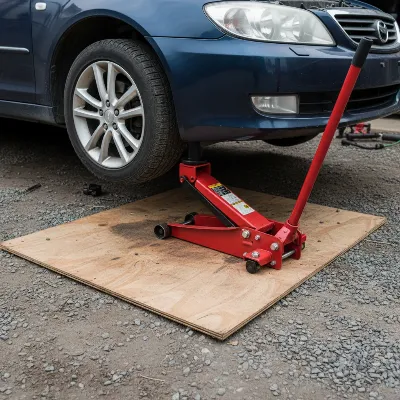 A floor jack safely positioned on a large plywood base on a dirt surface, lifting a car's wheel.
Lowering the Vehicle
Once your work is complete, carefully reverse the process. Slowly lift the vehicle just enough with the Floor Jack to relieve the weight from the jack stands. Remove the jack stands, being mindful of your hands and feet. Then, steadily and smoothly lower the vehicle back to the ground, ensuring it settles evenly. After the vehicle is fully lowered and stable, remove the Floor Jack and finally, the wheel chocks.
Essential Safety Precautions When Working on Soft Ground
Lifting a vehicle is inherently risky, and soft ground amplifies these dangers. Beyond proper stabilization, several crucial safety precautions must always be observed:
- Always use jack stands: A Floor Jack is designed for lifting, not for sustained support. Never work under a vehicle that is supported solely by a Floor Jack. Jack stands are engineered to hold static loads for extended periods.
- Inspect all equipment: Before every use, thoroughly inspect your Floor Jack and jack stands for any signs of damage, such as cracks, leaks, bent components, or rust. Ensure the hydraulic system of your jack is functioning correctly and that wheels (if applicable) roll smoothly.
- Never work under a vehicle supported only by a jack: This cannot be stressed enough. If the jack fails, the consequences can be catastrophic.
- Perform a “shake test”: Once your vehicle is resting securely on jack stands, gently try to shake it. If there is any instability or movement, re-evaluate your setup before proceeding.
- Avoid sloped areas: Even with stabilization, working on an incline significantly increases the risk of the vehicle rolling or the jack tipping. Always seek the flattest possible ground.
- Consider your jack type: Rolling Floor Jacks need to be able to move slightly as they lift the vehicle due to the arc of their lifting arm. Ensure your chosen base allows for this movement while still providing a stable platform. Bottle jacks, which lift vertically, don’t have this same requirement.
- Use wheel chocks: Always chock the wheels that remain on the ground to prevent any accidental rolling of the vehicle.
- Know your vehicle’s weight capacity: Ensure your Floor Jack and jack stands have a weight capacity that exceeds the weight of the vehicle you are lifting.
Maintenance and Bảo dưỡng Floor Jack
Proper maintenance ensures your Floor Jack remains a reliable and safe tool for years to come. After using your jack on dirt or dusty surfaces, it’s crucial to clean it thoroughly. Wipe down all moving parts and the exterior to prevent grime buildup, which can hinder performance and lead to rust. Regularly check for any signs of hydraulic fluid leaks; even small leaks can compromise the jack’s lifting power and stability. If your jack uses hydraulic fluid, check the fluid level periodically and top it off or replace it according to the manufacturer’s recommendations. Finally, always store your Floor Jack in a clean, dry place to prevent rust and corrosion, extending its lifespan and ensuring it’s ready for its next safe use.
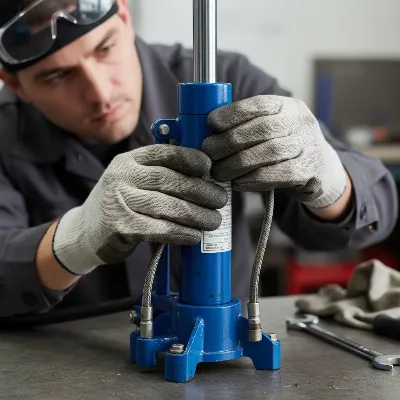 A technician inspecting a floor jack for leaks and wear during maintenance.
Conclusion
Working with a Floor Jack on soft terrain like dirt or gravel doesn’t have to be a risky endeavor. By understanding the principles of load distribution, selecting the appropriate stabilizing materials, and meticulously following established safety protocols, you can transform an unstable situation into a secure working environment. Always prioritize preparation, invest in reliable support materials, and never compromise on essential safety equipment like jack stands and wheel chocks. Your vigilance and careful practices are the best defense against accidents, ensuring that every lift is performed safely and efficiently. Prioritize safety in all lifting tasks – your well-being and the integrity of your vehicle depend on it.
What challenging terrain have you successfully tackled with your Floor Jack, and what was your secret to maintaining stability?
Frequently Asked Questions
Can I use a floor jack on grass?
Using a floor jack directly on grass is generally not recommended due to the unstable nature of the ground. The jack can easily sink or shift, creating a significant safety hazard. Always place a large, sturdy base, such as thick plywood or a steel plate, under the floor jack to distribute the weight and provide a firm foundation when working on grass.
What thickness of wood is best for a floor jack on dirt?
For optimal safety and stability when using a floor jack on dirt, a minimum of ¾-inch thick plywood is recommended. For heavier vehicles or very soft ground, using two layers of ¾-inch plywood or a solid wood plank of similar thickness (e.g., a 2×10 or 4×6) will provide even greater load distribution and resistance to sinking.
Why do rolling floor jacks need to move during lifting?
Rolling floor jacks are designed with a pivoting lift arm, meaning the point where they contact the vehicle changes angle as the vehicle is raised. For the jack to maintain proper contact and stability, its wheels must be able to roll slightly inward as the vehicle lifts. If the jack’s wheels are prevented from rolling, it can bind, tilt, or cause the vehicle to shift, leading to a dangerous situation.
