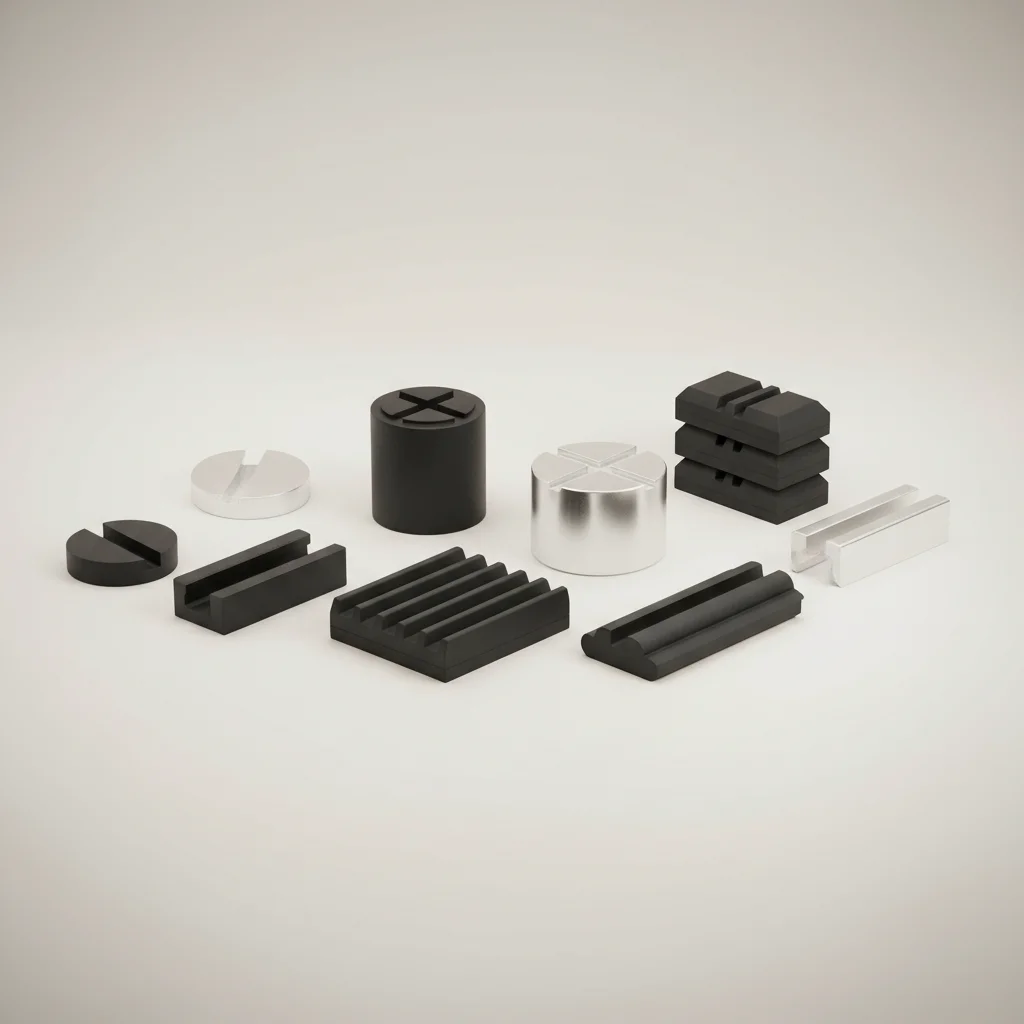
Floor jack adapters are often necessary for safe and effective lifting, especially when dealing with specific vehicle types or delicate undercarriages. While not every lift requires an adapter, using the correct one can prevent damage to your vehicle and ensure a stable lift point. This guide will detail when and why you should consider using floor jack adapters.
Understanding Floor Jack Adapters
Floor jack adapters are specialized attachments designed to fit onto the saddle of a floor jack. Their primary purpose is to provide a more secure and appropriate contact point between the jack and the vehicle’s frame or designated lift points. Without an adapter, the metal-on-metal contact of a standard jack saddle can scratch paint, deform pinch welds, or even slip, leading to dangerous situations.
There are various types of adapters, each designed for specific applications. Some are universal, offering a broad contact surface, while others are highly specialized for particular vehicle makes or models, such as those with unique frame designs or battery pack locations in electric vehicles.
When to Use a Pinch Weld Adapter
Pinch weld adapters are crucial when lifting vehicles that utilize pinch welds as their designated jacking points. Many modern cars, especially unibody designs, have these reinforced seams along the rocker panels. A standard floor jack saddle can easily bend or damage these pinch welds, leading to rust and structural integrity issues over time. A pinch weld adapter features a slot that cradles the pinch weld, distributing the load evenly and preventing damage. Always consult your vehicle’s owner’s manual to identify the correct jacking points.
Adapters for Specialty Vehicles and Lift Points
|
Our Picks for the Best Floor Jack in 2026
As an Amazon Associate I earn from qualifying purchases.
|
||
| Num | Product | Action |
|---|---|---|
| 1 | Low Profile Floor Jack 3 Ton (6600 lbs), Heavy Duty Hydraulic Jack for Car, Heavy-Duty Floor Jack with Dual Pistons Quick Lift Pump, Car Floor Jack with Lifting Range 3-1/8'' to 19-7/8'' |

|
| 2 | 3 Ton Low Profile, Aluminum and Steel Racing Floor Jack with Dual Pistons Quick Lift Pump for Sport Utility Vehicle, Lifting Range 3-15/16" min to 18-5/16" max, Net Weight 58.5 lb, Red |
|
| 3 | Dewalt DWHT83550 TOUGHSERIES Construction Jack |
|
| 4 | Floor Jack 3 Ton Capacity Fast Lift Service Jack Steel Heavy Duty Hydraulic Car Jack |
|
| 5 | DNA Motoring Low Profile Hydraulic Trolley Service/Floor Jack, 2 Ton (4000 lbs) Capacity, Lifting Range 5.1"-13", Blue, TOOLS-00474 |
|
| 6 | Floor Jack 2.5 Ton (5500 lbs), Low Profile Floor Jack with Single Piston Pump, Heavy Duty Steel Hydraulic Jack for Car, Jack for Car with Lifting Range 3.4'' to 14.6'' |
|
| 7 | 3 Ton Floor Jack (6600 lbs), Heavy Duty Hydraulic Jack for Car, Heavy-Duty Floor Jack with Single Piston Pump, Quick Lift Car Jack 3 ton with Lifting Range 5.5'' to 18.5'' |
|
| 8 | DNA Motoring TOOLS-00234 Low Profile Hydraulic Trolley Service/Floor Jack, 2 Ton (4000 lbs) Capacity, Lifting Range 5.1"-13", Black |
|
| 9 | VEVOR 2.5 Ton Low Profile, Heavy-Duty Steel Racing Floor Jack with Single Piston Lift Pump, Lifting Range 3.35"-14.96" |
|
| 10 | Amazon Basics Hydraulic Floor and Portable Car Jack, 2.2 Short Ton/ 2 Metric Ton/ 2 Tonne / 2000 kg Capacity, Slow Release, Red |
|
Certain vehicles, like sports cars with low ground clearance, electric vehicles with sensitive battery trays, or trucks with unique frame rails, often require specific adapters. Low-profile adapters can help reach recessed jacking points, while rubber or polyurethane pads can protect delicate surfaces from metal-on-metal contact. For electric vehicles, specialized adapters are becoming increasingly common to avoid damaging high-voltage components or battery enclosures. Always ensure the adapter’s material and design are compatible with the vehicle’s weight and the jack’s capacity.
Benefits of Using Floor Jack Adapters
- Prevents damage to vehicle undercarriage and paint.
- Ensures a more stable and secure lifting point.
- Distributes weight more evenly across the jacking point.
- Reduces the risk of the vehicle slipping off the jack.
- Extends the lifespan of your vehicle’s frame and components.
Choosing the Right Floor Jack Adapter
Selecting the correct adapter involves considering your vehicle type, the specific jacking points, and the material of the adapter itself. Rubber and polyurethane adapters offer excellent protection against scratches and provide some grip, making them ideal for most passenger vehicles. For heavier-duty applications or specific frame types, metal adapters with specialized shapes might be necessary. Always prioritize adapters made from durable materials that can withstand the weight and pressure of lifting.
Before purchasing, measure your jack’s saddle and compare it to the adapter’s specifications to ensure a snug fit. A loose adapter can be just as dangerous as no adapter at all. Read reviews and consider reputable brands known for their quality and safety standards.
Installation and Safety Tips
Installing a floor jack adapter is typically straightforward: simply place it securely onto the jack’s saddle. Before lifting, always double-check that the adapter is centered and stable. Position the jack and adapter directly under the vehicle’s designated lift point. Lift slowly and observe the contact point to ensure everything remains stable. Once the vehicle is lifted, always use jack stands for support before working underneath. Never rely solely on the floor jack, even with an adapter, for prolonged support.
