A floor jack is an indispensable tool for automotive maintenance, and its longevity and safe operation depend on proper care. Essential maintenance for a new floor jack includes regular cleaning, checking for hydraulic fluid leaks, topping off or changing hydraulic fluid with AW32 oil, lubricating moving parts, bleeding the system when necessary, and storing it fully lowered in a dry environment. Adhering to these practices ensures the jack remains reliable and safe for tasks like tire rotations and oil changes.
What is a Floor Jack?
A floor jack, often known as a trolley jack or service jack, is a powerful mechanical device designed to lift vehicles or heavy objects off the ground. Most commonly, it operates using hydraulic principles, leveraging fluid pressure to multiply the force applied by the user, allowing you to raise substantial weight with minimal effort. This process typically involves pumping a long handle, which pushes hydraulic fluid into a cylinder, extending a ram that, in turn, lifts a saddle positioned under the vehicle’s lift point.
Floor jacks are widely utilized in various settings, from professional automotive repair shops to home garages. Their primary application is to elevate a vehicle to perform maintenance tasks such as changing tires, inspecting the undercarriage, doing brake work, or making suspension repairs. Their wheeled design makes them highly maneuverable, allowing you to position them precisely under your vehicle’s designated lift points, providing both convenience and stability during the lifting process. For explore our automotive lifting reviews on this site.
Common Types of Floor Jacks on the Market
When you step into the world of vehicle lifting, you’ll encounter a few primary types of jacks, each suited for different needs and environments. Understanding these differences is crucial for selecting the right tool for your tasks and ensuring maximum efficiency and safety.
Hydraulic Floor Jack (Trolley Jack)
Hydraulic floor jacks are arguably the most ubiquitous lifting tools in any garage or workshop. They operate using hydraulic fluid, a pump, and a ram to create immense lifting power. These jacks typically feature a long handle for pumping and wheels for easy positioning, making them a go-to for many automotive tasks.
- Advantages: They boast high lifting capacities, often ranging from 2 to 4 tons, making them suitable for most passenger cars, SUVs, and light trucks. Their hydraulic mechanism allows for smooth, controlled lifting with relatively little effort. They also offer excellent stability due to their wide base and sturdy construction.
- Disadvantages: Hydraulic floor jacks can be bulky and heavy, especially steel models, which might make storage or transport less convenient for some users. While generally efficient, they can be more expensive than simpler mechanical alternatives.
- Applications: Ideal for professional garages, dedicated home mechanics, and anyone needing to perform frequent, heavy-duty lifting tasks like tire rotations, oil changes, or transmission work.
Pneumatic Floor Jack (Air Jack)
|
Our Picks for the Best Floor Jack in 2026
As an Amazon Associate I earn from qualifying purchases.
|
||
| Num | Product | Action |
|---|---|---|
| 1 | VEVOR 2.5 Ton Low Profile, Heavy-Duty Steel Racing Floor Jack with Single Piston Lift Pump, Lifting Range 3.35"-14.96" |

|
| 2 | 3 Ton Low Profile, Aluminum and Steel Racing Floor Jack with Dual Pistons Quick Lift Pump for Sport Utility Vehicle, Lifting Range 3-15/16" min to 18-5/16" max, Net Weight 58.5 lb, Red |
|
| 3 | DNA Motoring TOOLS-00234 Low Profile Hydraulic Trolley Service/Floor Jack, 2 Ton (4000 lbs) Capacity, Lifting Range 5.1"-13", Black |
|
| 4 | Dewalt DWHT83550 TOUGHSERIES Construction Jack |
|
| 5 | Floor Jack 3 Ton Capacity Fast Lift Service Jack Steel Heavy Duty Hydraulic Car Jack |
|
| 6 | Low Profile Floor Jack 3 Ton (6600 lbs), Heavy Duty Hydraulic Jack for Car, Heavy-Duty Floor Jack with Dual Pistons Quick Lift Pump, Car Floor Jack with Lifting Range 3-1/8'' to 19-7/8'' |
|
| 7 | DNA Motoring Low Profile Hydraulic Trolley Service/Floor Jack, 2 Ton (4000 lbs) Capacity, Lifting Range 5.1"-13", Blue, TOOLS-00474 |
|
| 8 | Amazon Basics Hydraulic Floor and Portable Car Jack, 2.2 Short Ton/ 2 Metric Ton/ 2 Tonne / 2000 kg Capacity, Slow Release, Red |
|
| 9 | Floor Jack 2.5 Ton (5500 lbs), Low Profile Floor Jack with Single Piston Pump, Heavy Duty Steel Hydraulic Jack for Car, Jack for Car with Lifting Range 3.4'' to 14.6'' |
|
| 10 | 3 Ton Floor Jack (6600 lbs), Heavy Duty Hydraulic Jack for Car, Heavy-Duty Floor Jack with Single Piston Pump, Quick Lift Car Jack 3 ton with Lifting Range 5.5'' to 18.5'' |
|
Pneumatic floor jacks, also known as air jacks or air-hydraulic jacks, are powerful tools that utilize compressed air to lift vehicles quickly and efficiently. These jacks integrate an air motor into their hydraulic system, meaning they combine the power of hydraulics with the speed and reduced manual effort of compressed air.
- Advantages: The most significant benefit is their speed and ease of use, as they require minimal manual input beyond operating an air valve. They are exceptionally effective for rapid lifting in high-volume environments, drastically cutting down on labor time. They are designed for heavy loads and offer robust lifting capabilities.
- Disadvantages: A primary drawback is the necessity of an air compressor for operation, which adds to the overall cost and setup. They can also be quite noisy in operation and are often larger and less portable than standard hydraulic floor jacks, making them less practical for smaller home garages.
- Applications: Best suited for large commercial workshops, heavy-duty repair shops, and industrial settings where frequent, rapid lifting of heavy vehicles like buses, trucks, or construction machinery is required.
Mechanical Floor Jack
Mechanical jacks rely on various non-hydraulic or non-pneumatic mechanisms to lift loads. While traditional “floor jacks” typically refer to wheeled hydraulic units, the term “mechanical jack” often encompasses smaller, manually operated jacks like scissor jacks or bottle jacks, which are commonly used for DIY and emergency situations. For the purpose of the user’s prompt, we’ll focus on the most common DIY mechanical options that serve similar lifting purposes.
- Scissor Jacks: These are often included as standard equipment in vehicles for emergency tire changes. They work by turning a screw mechanism that extends two hinged arms, lifting the vehicle.
- Advantages: Extremely compact, lightweight, and affordable. They are easy to store in a trunk and require no external power.
- Disadvantages: Lifting is slow and physically demanding, and they have a limited lifting capacity, typically 1 to 1.5 tons. They are not designed for extensive garage work or long-term support.
- Applications: Exclusively for roadside emergency tire changes or very minor, quick lifts where space is extremely limited.
- Bottle Jacks: These are compact hydraulic jacks with a vertical cylinder, resembling a bottle. While hydraulic, they fall into the “mechanical” operational category given their manual pump action, and offer a powerful lift in a small footprint.
- Advantages: Despite their small size, bottle jacks offer impressive lifting power and often have higher maximum lift heights compared to scissor jacks, suitable for heavier vehicles like trucks or SUVs with higher ground clearance. They are also relatively affordable.
- Disadvantages: Their vertical design means they are not suitable for vehicles with low ground clearance. They require a stable, level surface, and their small footprint can sometimes make them less stable than a large floor jack.
- Applications: Ideal for lifting heavy-duty vehicles, farm equipment, or any situation where high lifting capacity and vertical reach are needed in a compact tool, provided the vehicle has sufficient ground clearance.
Comparing Different Floor Jack Types
Choosing the right floor jack means weighing various factors against your specific needs. Here’s a detailed comparison to help you make an informed decision:
| Feature | Hydraulic Floor Jack (Trolley Jack) | Pneumatic Floor Jack (Air Jack) | Mechanical Jack (Scissor/Bottle Jack) |
|---|---|---|---|
| Lifting Mechanism | Hydraulic fluid, manual pump | Hydraulic fluid, compressed air | Screw mechanism (Scissor), Hydraulic fluid, manual pump (Bottle) |
| Load Capacity | 2-4 tons (common) | 5-20+ tons (heavy-duty) | 1-1.5 tons (Scissor), 2-20+ tons (Bottle) |
| Minimum Lift Height | Low profile designs available (3-5 inches) | Higher minimum height (6-10 inches typical) | Very low (Scissor), Higher (Bottle, 6-8 inches typical) |
| Maximum Lift Height | Moderate to high (18-24 inches) | Very high (20-30+ inches) | Limited (Scissor, 15-20 inches), High (Bottle, 15-25+ inches) |
| Weight | Heavy (steel models), Moderate (aluminum) | Very heavy | Lightweight (Scissor), Moderate (Bottle) |
| Price | Moderate to high | High | Low (Scissor), Low to moderate (Bottle) |
| Durability | High, robust construction | Very high, industrial-grade | Moderate (Scissor), High (Bottle) |
| Special Features | Wheeled mobility, quick-lift features | Rapid lifting, reduced manual effort | Compact storage (Scissor), High vertical lift for size (Bottle) |
| Application | General garage, DIY, professional | Heavy-duty workshops, commercial | Emergency roadside (Scissor), Trucks/SUVs with high clearance (Bottle) |
Guide to Choosing the Right Floor Jack
Selecting the perfect floor jack for your needs requires careful consideration. You want a tool that not only performs the job effectively but also ensures your safety. Here’s a comprehensive buying guide:
Determine Your Usage Needs
Before diving into specifications, clarify how and where you’ll be using your floor jack.
- Vehicle Type and Weight: This is paramount. Always choose a jack with a load capacity that is at least three-quarters of your vehicle’s gross weight, though a safety margin (1.5 times the vehicle weight) is always recommended. For small sedans, a 2-ton jack might suffice, but for larger SUVs, trucks, or vans, a 3-ton or 4-ton heavy-duty jack is essential. Overloading a jack is a serious safety hazard.
- Frequency of Use: If you’re an occasional DIYer, a standard hydraulic floor jack might be perfect. For frequent use in a busy workshop, investing in a more durable, perhaps aluminum (for lighter weight), or even a pneumatic jack might be more practical.
- Budget: Prices vary significantly across types and brands. Set a realistic budget, but remember that safety and durability should always take precedence over the cheapest option.
Key Factors to Consider When Buying
Once your needs are clear, evaluate these critical features:
- Load Capacity: As mentioned, verify the jack’s maximum weight rating. This is the single most important safety specification. Never compromise on this.
- Lift Height (Minimum and Maximum): Ensure the jack can fit under your vehicle’s lowest clearance points (minimum height) and raise it high enough to comfortably place jack stands and work (maximum height). Low-profile jacks are available for sports cars or vehicles with very limited ground clearance.
- Durability and Material Quality: Look for jacks made from high-quality steel (for strength and longevity) or aluminum (for lighter weight and portability). Check for robust construction, such as welded joints, reinforced frames, and high-quality hydraulic components. A durable jack is a safe and long-lasting investment.
- Brand and Supplier Reputation: Research reputable brands known for their quality, reliability, and customer support. While specific brand names can vary, consistently positive reviews and a good warranty are indicators of a trustworthy product.
- Safety Features: A reliable safety bypass valve is crucial to prevent overloading. Look for robust locking mechanisms and a stable saddle design that securely cradles the vehicle’s lift point. Smooth-operating release valves are also important for controlled lowering.
- Mobility and Maneuverability: For ease of use in a garage, look for jacks with strong, smooth-rolling wheels or swivel casters, especially if you need to move the jack around frequently or in tight spaces.
Safe Usage of Your Floor Jack
Safety should always be your top priority when working with a floor jack. Misuse can lead to serious injury or damage to your vehicle. Follow these steps for safe operation:
- Inspect Your Equipment: Before every use, visually inspect your floor jack for any signs of damage such as cracks, rust, fluid leaks, or worn components. Ensure the wheels roll smoothly and the release valve operates correctly. Never use a damaged jack.
- Prepare Your Workspace: Always work on a flat, hard, and level surface, such as concrete or asphalt. Never use a jack on soft ground, gravel, grass, or an incline, as this can cause the jack to shift, sink, or tip over. Clear the area of any clutter or debris that could cause a fall.
- Stabilize the Vehicle: Engage your vehicle’s parking brake and place wheel chocks behind the wheels that will remain on the ground. For front-end lifts, chock the rear wheels; for rear-end lifts, chock the front wheels.
- Locate Proper Lift Points: Consult your vehicle’s owner’s manual to identify the manufacturer-recommended lifting points. These are typically strong areas of the frame, pinch welds, or suspension components. Never place the jack under suspension arms, fuel tanks, plastic body panels, or parts not designed to bear the vehicle’s weight.
- Position the Jack: Center the jack’s saddle securely under the designated lift point. Ensure full contact between the jack’s lifting pad and the vehicle’s surface to prevent slipping.
- Lift Slowly and Steadily: Pump the jack handle smoothly and gradually to raise the vehicle. Avoid rapid or jerky movements. Keep an eye on the jack and the vehicle to ensure stability during the lift.
- ALWAYS Use Jack Stands: This is the most critical safety rule. A floor jack is designed for lifting, not for sustaining a load. Once the vehicle is at the desired height, immediately place appropriately rated jack stands under the vehicle’s designated support points (often different from the lift points, check your manual). Lower the vehicle gently onto the jack stands until they bear the full weight.
- Never Work Under a Jack-Supported Load: Once the vehicle is on jack stands, you can remove the floor jack, or at least relieve pressure, before working underneath. Never trust a jack alone to hold a vehicle while you are beneath it.
- Lower the Vehicle Carefully: When you are finished, ensure the area is clear of tools and personnel. Raise the vehicle slightly with the floor jack to remove the jack stands. Then, slowly and controllably open the release valve to lower the vehicle back to the ground. Remove wheel chocks.
> “In over a decade of hands-on experience, the single most common mistake I’ve seen is relying solely on a floor jack. Always, without exception, use jack stands. Your life, and the life of your vehicle, depends on it.” – Admin, ReviewHoster.com
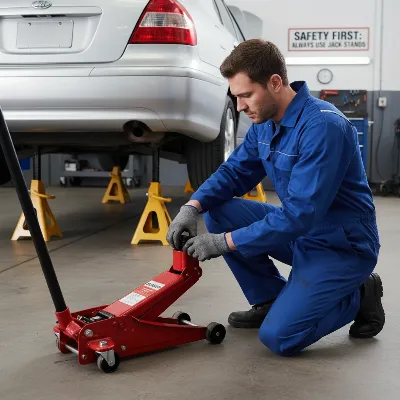 Technician inspecting a hydraulic floor jack and placing jack stands under a raised car for safety.
Maintenance and Upkeep of Your Floor Jack
To ensure your floor jack remains a reliable and safe tool for years to come, regular maintenance is indispensable. A little attention goes a long way in preserving its performance and extending its lifespan.
- Keep It Clean: After every use, wipe down your entire floor jack with a clean, dry cloth. Dirt, dust, grease, and fluid spills can accumulate around moving parts, wheels, and seals, leading to corrosion and reduced performance over time. Pay special attention to the piston, handle pivots, casters, and the release valve area. For stubborn grime, use a mild degreaser, ensuring it doesn’t enter the pump or valve components, then dry thoroughly. Compressed air can help clear debris from tight crevices.
- Check for Hydraulic Fluid Leaks: For hydraulic models, regularly inspect for any signs of fluid leaks. Pooled fluid under the jack, reduced lifting height, or a “spongy” feel when pumping are indicators of a compromised hydraulic system. If you notice a leak, identify the source and address it.
- Top Off or Change Hydraulic Fluid: Hydraulic fluid levels can decrease over time. To check, fully lower the jack, remove the fill plug (refer to your manual for location), and the fluid should be level with the bottom of the fill hole. If low, top off with only jack-specific hydraulic oil, such as AW32. Never use brake fluid, motor oil, or any other fluid, as these can severely damage internal seals and components. Refer to your owner’s manual for recommended fluid change intervals.
- Lubricate Moving Parts: Keep all moving metal-to-metal contact points well-lubricated. Apply grease to pivot points, axles, and wheels. Lightly oil the handle socket and the threads of the release valve mechanism. Avoid over-lubricating the piston or seal areas, as this can attract dust and debris.
- Bleed the System (If Needed): If your hydraulic jack exhibits erratic lifting, a spongy feel, or fails to lift to its full height, air might be trapped in the hydraulic system. To bleed the system, fully lower the jack, locate the release valve, and open it (usually by twisting the pump rod counter-clockwise). Pump the jack handle several times, allowing air to escape. You might hear a hiss or see bubbles. Close the release valve tightly, and recheck the fluid level, topping off if necessary. Repeat until smooth operation is restored.
- Proper Storage: Always store your floor jack fully lowered to relieve pressure on the hydraulic system, protecting the seals and components. Keep it in a dry, clean environment, ideally covered, to prevent rust, corrosion, and dust accumulation. Store it upright on its base, never on its side, to avoid air infiltration into the hydraulic system.
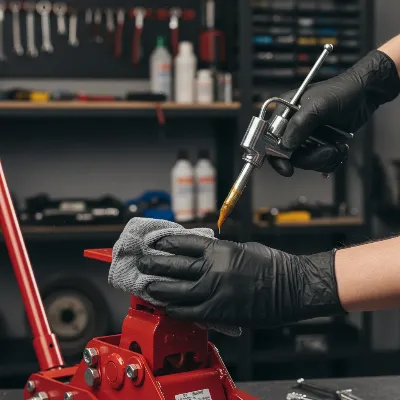 Hands cleaning and lubricating a floor jack in a home garage setting as part of regular maintenance.
Conclusion
Your floor jack is more than just a tool; it’s a crucial piece of safety equipment that empowers your DIY automotive projects. By understanding the different types available, making an informed choice based on your specific needs, and committing to regular maintenance and safe operating procedures, you ensure its reliability and longevity. A well-chosen and properly maintained floor jack will serve you safely and efficiently for many years, making those car maintenance tasks a breeze.
What’s the one maintenance tip you wish you knew when you first got your floor jack?
Frequently Asked Questions
How often should I check my hydraulic floor jack’s fluid?
For optimal performance and safety, it’s recommended to check your hydraulic floor jack’s fluid level every three to six months, or after every few heavy uses. Regular checks help identify leaks or low fluid levels before they impact performance.
Can I use motor oil in my hydraulic floor jack?
Absolutely not. You should never use motor oil, brake fluid, or any non-specified fluid in your hydraulic floor jack. Doing so can cause severe damage to the internal seals and components, leading to jack failure and potentially dangerous situations. Always use hydraulic jack-specific oil, typically labeled as AW32 or similar.
What are the key differences between hydraulic and pneumatic floor jacks?
Hydraulic floor jacks use manual pumping to lift vehicles, offering 2-4 tons of capacity for general garage use. Pneumatic floor jacks, or air jacks, use compressed air for rapid lifting, providing 5-20+ tons of capacity, ideal for heavy-duty commercial workshops.
Why is it crucial to use jack stands with a floor jack?
It is crucial to always use jack stands because a floor jack is designed for lifting a vehicle, not for sustaining its weight. Jack stands provide stable, long-term support, preventing serious injury or vehicle damage if the jack fails.
How do I choose the right floor jack for my vehicle?
To choose the right floor jack, determine your vehicle’s gross weight and select a jack with a load capacity at least 1.5 times that weight. Consider the minimum and maximum lift heights required, the jack’s material (steel for strength, aluminum for portability), and essential safety features like a bypass valve.
What are the signs that my hydraulic floor jack needs bleeding?
Your hydraulic floor jack likely needs bleeding if it exhibits erratic lifting, feels spongy when pumped, or fails to reach its full lifting height. These symptoms indicate air is trapped within the hydraulic system, which can be resolved by following the bleeding procedure in your owner’s manual.
Frequently Asked Questions
How often should I check my hydraulic floor jack's fluid?
For optimal performance and safety, it's recommended to check your hydraulic floor jack's fluid level every three to six months, or after every few heavy uses. Regular checks help identify leaks or low fluid levels before they impact performance.
Can I use motor oil in my hydraulic floor jack?
Absolutely not. You should never use motor oil, brake fluid, or any non-specified fluid in your hydraulic floor jack. Doing so can cause severe damage to the internal seals and components, leading to jack failure and potentially dangerous situations. Always use hydraulic jack-specific oil, typically labeled as AW32 or similar.
What are the key differences between hydraulic and pneumatic floor jacks?
Hydraulic floor jacks use manual pumping to lift vehicles, offering 2-4 tons of capacity for general garage use. Pneumatic floor jacks, or air jacks, use compressed air for rapid lifting, providing 5-20+ tons of capacity, ideal for heavy-duty commercial workshops.
Why is it crucial to use jack stands with a floor jack?
It is crucial to always use jack stands because a floor jack is designed for lifting a vehicle, not for sustaining its weight. Jack stands provide stable, long-term support, preventing serious injury or vehicle damage if the jack fails.
How do I choose the right floor jack for my vehicle?
To choose the right floor jack, determine your vehicle's gross weight and select a jack with a load capacity at least 1.5 times that weight. Consider the minimum and maximum lift heights required, the jack's material (steel for strength, aluminum for portability), and essential safety features like a bypass valve.
What are the signs that my hydraulic floor jack needs bleeding?
Your hydraulic floor jack likely needs bleeding if it exhibits erratic lifting, feels spongy when pumped, or fails to reach its full lifting height. These symptoms indicate air is trapped within the hydraulic system, which can be resolved by following the bleeding procedure in your owner's manual.
Maintain Your Floor Jack for Longevity and Safety
Regular maintenance of your floor jack is crucial for its performance and your safety. Follow these steps to keep your hydraulic floor jack in top condition.
After every use, wipe down your entire floor jack with a clean, dry cloth to remove dirt, dust, grease, and fluid spills. Pay special attention to the piston, handle pivots, casters, and the release valve area to prevent corrosion and reduced performance.
Regularly inspect your hydraulic floor jack for any signs of fluid leaks, such as pooled fluid or a spongy feel when pumping. If a leak is detected, identify the source and address it promptly to prevent system compromise.
Check fluid levels by fully lowering the jack and removing the fill plug; fluid should be level with the bottom of the hole. If low, top off with jack-specific hydraulic oil (e.g., AW32). Never use brake fluid or motor oil, as they can damage seals.
Apply grease to pivot points, axles, and wheels, and lightly oil the handle socket and release valve threads. This lubrication prevents wear and ensures smooth operation, but avoid over-lubricating piston areas to prevent dust accumulation.
If the jack lifts erratically or feels spongy, air might be trapped. Fully lower the jack, open the release valve, and pump the handle several times to expel air. Close the valve, recheck fluid, and repeat until smooth operation is restored.

Some solid advice, especially on lubricating moving parts. My only minor gripe is that it didn’t go into more detail about specific types of grease to use for different components. I ended up just using some general-purpose grease, and it seems okay, but I’d have liked a more precise recommendation. Still, it’s helpful for general upkeep.
This was super helpful! I just got a new floor jack and wanted to make sure I started off right. The tip about storing it fully lowered in a dry environment is something I hadn’t considered, but it makes perfect sense for longevity. I want this thing to last for years of DIY projects.
Great tips here! I’ve been meaning to get around to some proper maintenance for my jack. I usually just wipe it down, but the advice about checking for hydraulic fluid leaks and topping it off with AW32 oil is something I’ll be doing this weekend. It’s good to know what to look for to keep it safe for oil changes.
I’ve always been pretty good about cleaning my tools, but I never really thought about bleeding the system on my floor jack. After reading this, I gave it a try on my older 3-ton jack, and wow, what a difference! It feels much smoother and more responsive now. Definitely a game-changer for keeping it reliable for tire rotations.