No, you should never leave a car on a floor jack overnight. Floor jacks are designed for temporary lifting and lowering of vehicles, not for sustained support. Relying solely on a floor jack for extended periods, such as overnight, poses significant safety risks due to potential hydraulic system failure, inherent instability, and the high risk of severe injury or vehicle damage if the jack collapses. Always use properly rated jack stands for any vehicle support lasting more than a few minutes.
What is a Floor Jack and How Does It Work?
A floor jack is an essential tool in any garage, designed specifically for lifting heavy vehicles with relative ease. Typically, floor jacks utilize a hydraulic system to generate immense lifting force. When you pump the handle, hydraulic fluid is pushed from a reservoir into a cylinder, which in turn extends a piston, raising the saddle and lifting the vehicle. This powerful mechanism allows a single person to lift a substantial portion of a car’s weight effortlessly.
Floor jacks are invaluable for a variety of automotive tasks, including changing a flat tire, inspecting brakes, performing oil changes, or gaining access to the undercarriage for more extensive repairs. Their ability to quickly and efficiently lift a vehicle makes them a go-to tool for initial elevation. However, it’s crucial to understand that their primary function is lifting, not sustaining a load indefinitely. For see our automotive lifting recommendations on this site.
Why You Should NEVER Leave a Car on a Floor Jack Overnight
Despite their robust appearance and lifting capability, floor jacks are not designed for long-term vehicle support. Leaving a car on a floor jack overnight or for any extended period poses significant safety hazards that can lead to catastrophic accidents, severe injuries, or irreversible damage to your vehicle.
Hydraulic System Failure
The most common type of floor jack, the hydraulic floor jack, relies on a sealed hydraulic system to maintain its lift. This system, while powerful, is susceptible to failure over time. Internal seals and O-rings can degrade, leading to slow hydraulic fluid leaks. Even a tiny, imperceptible leak can cause the jack to slowly lose pressure and settle downwards. In worst-case scenarios, a sudden seal failure or component malfunction can result in an immediate and rapid collapse of the jack, dropping the vehicle without warning. Imagine coming back to your garage only to find your car crashed onto the floor, or worse, if someone were working nearby.
Instability and Slippage
Floor jacks are designed with wheels to allow for easy positioning and movement during the lifting process. While convenient, these wheels, combined with a relatively narrow contact patch on the vehicle, make them inherently less stable for prolonged support compared to static jack stands. The jack can roll, shift, or even tip over if the ground is uneven, if the vehicle is bumped, or if any lateral force is applied. A slight incline in your driveway, a minor vibration, or even strong winds can be enough to dislodge the jack from its precarious position. Such instability dramatically increases the risk of the vehicle slipping off the jack and falling.
Jacks Are for Lifting, Not Supporting
|
Our Picks for the Best Floor Jack in 2026
As an Amazon Associate I earn from qualifying purchases.
|
||
| Num | Product | Action |
|---|---|---|
| 1 | Low Profile Floor Jack 3 Ton (6600 lbs), Heavy Duty Hydraulic Jack for Car, Heavy-Duty Floor Jack with Dual Pistons Quick Lift Pump, Car Floor Jack with Lifting Range 3-1/8'' to 19-7/8'' |

|
| 2 | DNA Motoring Low Profile Hydraulic Trolley Service/Floor Jack, 2 Ton (4000 lbs) Capacity, Lifting Range 5.1"-13", Blue, TOOLS-00474 |
|
| 3 | Floor Jack 2.5 Ton (5500 lbs), Low Profile Floor Jack with Single Piston Pump, Heavy Duty Steel Hydraulic Jack for Car, Jack for Car with Lifting Range 3.4'' to 14.6'' |
|
| 4 | VEVOR 2.5 Ton Low Profile, Heavy-Duty Steel Racing Floor Jack with Single Piston Lift Pump, Lifting Range 3.35"-14.96" |
|
| 5 | Dewalt DWHT83550 TOUGHSERIES Construction Jack |
|
| 6 | DNA Motoring TOOLS-00234 Low Profile Hydraulic Trolley Service/Floor Jack, 2 Ton (4000 lbs) Capacity, Lifting Range 5.1"-13", Black |
|
| 7 | 3 Ton Low Profile, Aluminum and Steel Racing Floor Jack with Dual Pistons Quick Lift Pump for Sport Utility Vehicle, Lifting Range 3-15/16" min to 18-5/16" max, Net Weight 58.5 lb, Red |
|
| 8 | 3 Ton Floor Jack (6600 lbs), Heavy Duty Hydraulic Jack for Car, Heavy-Duty Floor Jack with Single Piston Pump, Quick Lift Car Jack 3 ton with Lifting Range 5.5'' to 18.5'' |
|
| 9 | Floor Jack 3 Ton Capacity Fast Lift Service Jack Steel Heavy Duty Hydraulic Car Jack |
|
| 10 | Amazon Basics Hydraulic Floor and Portable Car Jack, 2.2 Short Ton/ 2 Metric Ton/ 2 Tonne / 2000 kg Capacity, Slow Release, Red |
|
This is a fundamental principle of automotive safety. Floor jacks are engineered to raise and lower a vehicle. Jack stands, on the other hand, are specifically engineered to hold a vehicle securely in a raised position for extended periods. Jack stands feature a solid, mechanical locking mechanism that cannot fail due to hydraulic leaks or shifting pressure. Using a floor jack as a substitute for jack stands is a dangerous misuse of the tool, going against manufacturer recommendations and established safety protocols.
Risk of Severe Injury and Vehicle Damage
The most severe consequence of a floor jack failure is the potential for grave injury or fatality to anyone working under or near the vehicle. A vehicle weighing thousands of pounds can exert immense crushing force if it falls. The impact can cause broken bones, severe head trauma, internal injuries, or death. Beyond personal harm, a falling vehicle can sustain significant damage to its undercarriage, suspension, brakes, or body panels, turning a routine repair into an expensive catastrophe.
“A hydraulic jack is a lifting tool, not a holding tool. Relying on it for long-term support is like trusting a rope bridge with frayed ends – it might hold, but the risk of failure is too high to ignore.” – ReviewHoster Admin, Automotive Safety Expert
Jack Stands: The Safe and Essential Alternative
When it comes to supporting a vehicle for any length of time, jack stands are not just recommended; they are an absolute necessity. Unlike floor jacks, which rely on hydraulic pressure, jack stands are mechanical devices designed for static support. They feature a solid steel construction with a wide, stable base and a robust ratchet or pin-style locking mechanism that physically secures the vehicle at a desired height.
Jack stands provide a far greater margin of safety because:
- Mechanical Lock: Their height adjustment is secured by a mechanical lock, such as a sturdy pin or a pawl and ratchet system, which cannot fail due to hydraulic fluid leaks.
- Fixed Position: Once set, jack stands are stationary and do not have wheels, eliminating the risk of rolling or shifting.
- Enhanced Stability: Their broad, multi-legged base distributes the vehicle’s weight over a larger area, offering superior stability compared to the single-point contact of a floor jack.
Think of it this way: the floor jack gets the car up, and the jack stands keep it there. For any task that requires you to be under the vehicle, or if the vehicle needs to remain elevated for more than a few minutes, always transfer the load from the floor jack to appropriately rated jack stands.
Proper and Safe Use of a Floor Jack and Jack Stands
Ensuring safety when lifting a vehicle involves more than just using the right tools; it requires a methodical approach and attention to detail. Follow these steps to safely lift and support your car.
Choosing the Right Equipment
- Capacity: Always select a floor jack and jack stands with a weight capacity that significantly exceeds the weight of your vehicle. For example, if your car weighs 3,000 lbs (1.5 tons), opt for 2-ton or 3-ton capacity jacks and stands.
- Quality: Invest in high-quality, reputable brands. Inspect your equipment regularly for any signs of wear, damage, rust, or hydraulic leaks. Never use compromised equipment.
- Quantity: You will typically need at least two jack stands for lifting one end of a vehicle, and ideally four if you plan to lift the entire car.
Preparing Your Workspace
A safe lifting operation begins with a safe environment.
- Level and Stable Surface: Always work on a flat, hard, and stable surface, such as a concrete garage floor. Never lift a vehicle on grass, dirt, gravel, or sloped driveways, as these can cause the jack or stands to sink, shift, or tip.
- Engage Parking Brake: Ensure the vehicle’s parking brake is fully engaged.
- Wheel Chocks: Place wheel chocks firmly against the tires that remain on the ground. For example, if lifting the front, chock the rear wheels. If lifting the rear, chock the front wheels. This prevents unintended rolling.
Correct Lifting and Support Points
Consult your vehicle’s owner’s manual to locate the designated jack points and jack stand points. These are reinforced areas on the vehicle’s frame or suspension specifically designed to safely bear the weight. Using incorrect points can damage your vehicle’s undercarriage, fuel lines, brake lines, or body panels, and compromise stability.
Step-by-Step Safe Lifting Procedure
- Position the Vehicle: Drive your car onto the level surface and engage the parking brake. Place wheel chocks.
- Locate Jack Point: Identify the correct jack point for the area you intend to lift (e.g., central front or rear jack point, or a side jack point).
- Position Floor Jack: Roll the floor jack under the designated jack point, ensuring it is centered and stable.
- Lift the Vehicle: Slowly and steadily pump the floor jack handle to raise the vehicle to a height slightly above where the jack stands will be placed. Avoid rapid lifting.
- Place Jack Stands: Slide the jack stands under the vehicle at the designated jack stand points. Adjust their height so they are snug against the vehicle’s frame or strong suspension components.
- Lower onto Stands: Slowly release the pressure on the floor jack, allowing the vehicle to gently settle onto the jack stands. Ensure the vehicle is fully supported by the stands and stable.
- Remove Floor Jack (or Use as Extra Safety): Once the vehicle is securely resting on the jack stands, you can remove the floor jack. Some technicians choose to keep the floor jack lightly supporting the vehicle at a secondary point, just barely touching, as an extra layer of redundancy, but the primary load must be on the jack stands.
- Test Stability: Before working under the vehicle, give it a gentle shake to confirm it is stable and secure on the jack stands.
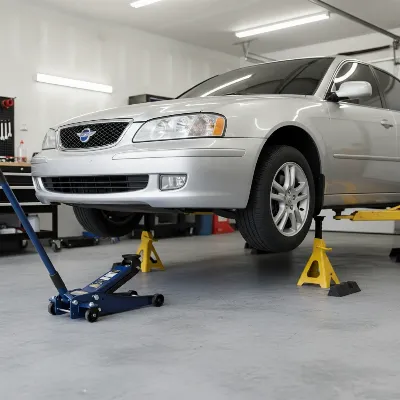 A car securely supported on robust jack stands with a floor jack removed, demonstrating safe vehicle lifting practice.
Maintenance for Your Lifting Equipment
Proper maintenance of your floor jack and jack stands is crucial for their longevity and, more importantly, for your safety. Neglecting maintenance can lead to equipment failure when you least expect it.
- Regular Inspection: Before each use, visually inspect your floor jack for any signs of hydraulic fluid leaks, bent components, cracks, or excessive rust. Check jack stands for bent legs, damaged welds, or issues with the locking mechanism. If you find any damage, do not use the equipment.
- Hydraulic Fluid Check: For hydraulic floor jacks, check the fluid level periodically according to the manufacturer’s instructions. Top up with the correct hydraulic oil if necessary. If your jack consistently leaks fluid, it’s a sign of a failing seal that needs professional repair or replacement.
- Cleaning and Lubrication: Keep your equipment clean from dirt, grease, and debris. Lubricate moving parts of the floor jack, such as the pump mechanism and pivot points, to ensure smooth operation.
- Proper Storage: Store floor jacks and jack stands in a dry, clean place to prevent rust and corrosion. Do not expose them to harsh weather conditions.
Conclusion
The question “Can you leave a car on a floor jack overnight safely?” has a resounding answer: no. A floor jack is engineered for the temporary task of lifting, not for the sustained support of a heavy vehicle. The risks associated with hydraulic failure, inherent instability, and the potential for severe injury or vehicle damage are simply too high to justify this dangerous practice. Always, without exception, use robust, properly rated jack stands to support your vehicle whenever it needs to be elevated for any period longer than the immediate lift. Prioritizing safety through correct equipment usage and diligent maintenance ensures peace of mind and protects both you and your valuable vehicle.
What are your experiences with vehicle lifting, and what safety tips do you swear by in your garage?
Frequently Asked Questions
Why can’t a hydraulic floor jack hold a car for long periods?
Hydraulic floor jacks use fluid pressure and seals to maintain their lift. Over time, these seals can degrade, or minor leaks can occur, causing the jack to slowly lose pressure and lower the vehicle. They are designed for dynamic lifting and lowering, not static load holding.
What is the maximum duration I can leave a car on a floor jack?
A car should not be left on a floor jack for any significant duration. Its use should be limited to the time it takes to position jack stands and transfer the vehicle’s weight. Once jack stands are in place, the floor jack should be removed or only lightly supporting the vehicle as a secondary backup.
Can I use bricks or wood blocks instead of jack stands?
No, never use bricks, cinder blocks, or stacks of wood as substitutes for proper jack stands. These materials are not designed to withstand concentrated, dynamic loads and can easily crack, crumble, or shift, leading to immediate vehicle collapse. Always use certified jack stands.
How do I know if my jack stands are safe to use?
Inspect your jack stands before each use for any signs of damage, such as bent legs, cracks in welds, or a faulty locking mechanism. Ensure they have a weight capacity that exceeds your vehicle’s weight. If there’s any doubt about their integrity, replace them immediately.
What should I do if my car falls off a floor jack?
If your car falls off a floor jack (or even jack stands), immediately move to a safe distance. Do not attempt to re-lift the vehicle or get underneath it without a thorough assessment of the damage and a plan for safe recovery. Inspect the vehicle for structural damage, and critically evaluate the equipment and procedures used to understand what went wrong before attempting any further work.
Frequently Asked Questions
Why can't a hydraulic floor jack hold a car for long periods?
Hydraulic floor jacks rely on fluid pressure and internal seals to maintain their lift. Over time, these seals can degrade or develop minor leaks, causing the jack to slowly lose pressure and lower the vehicle. They are engineered for dynamic lifting and lowering, not for static load holding over extended durations.
What is the maximum duration I can leave a car on a floor jack?
A car should not be left on a floor jack for any significant duration. Its use should be limited to the time it takes to position jack stands and safely transfer the vehicle's weight. Once jack stands are securely in place, the floor jack should be removed or used only as a light, secondary backup.
Can I use bricks or wood blocks as substitutes for jack stands?
No, you should never use bricks, cinder blocks, or stacks of wood as substitutes for proper jack stands. These materials are not designed to withstand concentrated, dynamic loads and can easily crack, crumble, or shift, leading to an immediate and dangerous vehicle collapse. Always use certified jack stands with appropriate weight ratings.
How do I know if my jack stands are safe to use?
Before each use, inspect your jack stands for any signs of damage, such as bent legs, cracks in welds, or a faulty locking mechanism. Ensure they have a weight capacity that significantly exceeds your vehicle's weight, for example, a 3,000 lb car needs at least 2-ton capacity stands. If there is any doubt about their integrity, replace them immediately.
What should I do if my car falls off a floor jack?
If your car falls off a floor jack (or even jack stands), immediately move to a safe distance away from the vehicle. Do not attempt to re-lift the vehicle or get underneath it without a thorough assessment of the damage and a plan for safe recovery. Inspect the vehicle for structural damage, and critically evaluate the equipment and procedures used to understand what went wrong before attempting any further work.
Safely Lift and Support a Car
Follow these steps to safely lift your vehicle using a floor jack and secure it with jack stands for any repair or maintenance task.
Drive your car onto a flat, hard surface like a concrete garage floor. Engage the parking brake fully and place wheel chocks firmly against the tires that will remain on the ground to prevent unintended rolling.
Consult your vehicle's owner's manual to locate the designated jack point. Position the floor jack under this point, ensuring it is centered and stable. Slowly and steadily pump the handle to raise the vehicle to a height slightly above where the jack stands will be placed.
Slide appropriately rated jack stands under the vehicle at the designated jack stand points, as specified in your owner's manual. Adjust their height so they are snug against the vehicle's frame or strong suspension components. Slowly release the floor jack pressure, allowing the vehicle to gently settle onto the jack stands, ensuring full support and stability.
Once the vehicle is securely resting on the jack stands, give it a gentle shake to confirm it is stable and secure. You can then remove the floor jack, or keep it lightly supporting the vehicle at a secondary point as an extra layer of redundancy, but the primary load must be on the jack stands.

Absolutely essential reading for anyone with a floor jack. The risk of severe injury or vehicle damage if the jack collapses is no joke. I’ve always followed this rule, but it’s good to have the reasons laid out so clearly. This should be mandatory reading for new mechanics.
This is such a crucial reminder! I’ve seen guys at the shop leave cars on jacks for hours, and it always makes me nervous. The point about hydraulic system failure is spot on. Always better to be safe and use those jack stands, even for quick jobs. Great advice for anyone working on their own car.
I appreciate the safety tips, but I wish there was more detail on specific jack stand brands or types that are best for different vehicles. It’s good to know not to leave a car on a floor jack overnight, but sometimes finding the right jack stands can be just as confusing. Still, the warning about instability is important.
Good info here. I’ve always been pretty careful, but it’s easy to get complacent. The explanation of how a floor jack’s hydraulic system works really highlights why it’s not meant for long-term support. I usually grab my jack stands right away, but this makes me double-check that habit.