Choosing the right floor jack is a pivotal decision for any mechanic, whether you’re a seasoned professional or a dedicated DIY enthusiast. It’s not just about lifting capacity; it’s about investing in a tool that aligns with your specific needs, budget, and workspace. In 2026, the primary debate often boils down to the core construction material: aluminum or steel. Each offers distinct advantages and trade-offs in terms of portability, durability, and cost. This comprehensive guide will dissect the differences between aluminum and steel floor jacks, exploring their characteristics, ideal applications, and what to look for when making your purchase, ensuring you select the perfect lifting partner for your garage.
What is a Floor Jack? (Definition and Applications)
A floor jack is a crucial hydraulic lifting device engineered to raise vehicles safely for maintenance, repairs, or tire changes. Utilizing hydraulic fluid and a pump mechanism, it generates pressure to elevate a saddle that supports the vehicle’s chassis or axle. These versatile tools are indispensable in diverse settings, from home garages and mobile repair units to professional automotive workshops and racing pits, providing essential leverage for accessing vehicle undercarriages.
Common applications of floor jacks include routine tasks like oil changes and tire rotations, as well as more complex projects such as brake replacements, suspension work, and exhaust system repairs. Their ability to quickly and safely lift substantial weight makes them fundamental for nearly any task requiring a vehicle to be elevated off the ground.
Types of Floor Jacks: Understanding the Core Differences
While the material (aluminum or steel) is a significant differentiator for many floor jacks, especially the popular trolley-style hydraulic models, it’s also helpful to understand the broader categories. Most commonly, you’ll encounter hydraulic floor jacks, but pneumatic and mechanical jacks offer specialized uses. The aluminum versus steel discussion predominantly applies to the construction of hydraulic floor jacks, which are the focus for most general automotive lifting tasks.
Hydraulic Floor Jacks (Aluminum vs. Steel Construction)
Hydraulic floor jacks rely on fluid pressure to lift vehicles and are by far the most prevalent type for automotive use. The choice between aluminum and steel construction directly impacts their weight, portability, and long-term durability, making it a critical consideration for buyers. Steel models are traditional workhorses, known for their robustness, while aluminum versions offer a lightweight, more maneuverable alternative, often favored in performance-oriented settings.
Pneumatic Floor Jacks
Pneumatic floor jacks, also known as air jacks, use compressed air to lift a vehicle quickly and efficiently. These jacks are typically found in large professional workshops or on production lines where speed and repetitive lifting are paramount. They require an air compressor to operate and can be noisy, but their high efficiency and rapid lift capabilities are unmatched for high-volume use.
Mechanical Floor Jacks
Mechanical floor jacks, such such as scissor jacks, operate using a screw or lever mechanism rather than hydraulics or air. They are generally more compact and less expensive but require more manual effort to operate and have limited lifting capacities. Often included with vehicles for emergency tire changes, they are best suited for light-duty, infrequent use rather than regular garage work.
Aluminum Floor Jacks: The Lightweight Advantage
Aluminum floor jacks have carved out a significant niche, particularly among users who prioritize portability and ease of handling. Constructed primarily from high-grade aluminum alloys, these jacks offer a substantial weight reduction—often 30-50% lighter than their steel counterparts—without compromising on strength for their rated capacity. This makes them significantly easier to transport, reposition, and store, a major benefit for mobile mechanics, track-day enthusiasts, or anyone with limited garage space.
The benefits extend beyond just weight. Aluminum naturally resists corrosion, making these jacks a smart choice in humid environments or for outdoor use where rust is a concern. Many modern aluminum jacks also feature advanced designs like dual-piston pumps, which provide quicker lifting with fewer handle strokes, saving valuable time and effort during operations. Their low-profile designs often make them ideal for reaching under sports cars and vehicles with minimal ground clearance.
However, the advantages come with certain trade-offs. Aluminum jacks typically command a higher price tag due to material processing costs and their premium positioning in the market. While durable, some lower-cost aluminum models might feature bolted frames that could loosen over time or softer metals prone to frame distortion under consistent, heavy daily use, making them potentially less rugged for professional shops with high-frequency demands compared to robust steel alternatives.
Steel Floor Jacks: The Durable Workhorse
Steel floor jacks are the traditional heavyweights of the automotive lifting world, renowned for their unparalleled durability, stability, and lower cost. Built from robust steel frames, these jacks are designed to withstand the rigors of frequent, heavy-duty use in demanding professional garage environments. Their substantial weight contributes to their inherent stability, providing a solid and reassuring platform when lifting heavier vehicles such as trucks, SUVs, muscle cars, or classic restorations.
One of the most appealing aspects of steel jacks is their affordability. Generally, steel models are more economical than aluminum jacks with the same lifting capacity, making them an excellent choice for budget-conscious home DIYers or fixed-location workshops where portability isn’t a primary concern. Their sturdy construction means they are often built to last for decades, offering a reliable investment for long-term projects and daily shop operations.
The primary drawback of steel floor jacks is their weight. Weighing significantly more than aluminum models—often over 80-100 pounds for a 3-ton capacity jack—they can be cumbersome to move around the garage or lift into a service vehicle. While robust, steel is also susceptible to rust and corrosion, particularly in damp environments, requiring more diligent maintenance to prevent degradation over time. Despite their heft, for applications demanding maximum strength and stability without the need for frequent transport, steel jacks remain the preferred choice for many professionals.
Aluminum vs. Steel Floor Jacks: A Detailed Comparison
When deciding between an aluminum and steel floor jack, understanding the key differences across various criteria is essential. This table provides a quick overview to help you weigh the pros and cons based on your specific needs.
| Criteria | Aluminum Floor Jacks | Steel Floor Jacks |
|---|---|---|
| Weight | Significantly lighter (30-50% less) | Much heavier, contributing to stability |
| Cost | Higher upfront cost, premium pricing | More affordable, budget-friendly |
| Durability | Good, but some models can be less rugged for daily pro use; bolted frames may loosen | Excellent, built for heavy-duty, frequent use |
| Portability | Highly portable, easy to maneuver and transport | Less portable, cumbersome to move |
| Corrosion Resistance | Naturally resistant to rust and corrosion | Prone to rust if not properly maintained |
| Typical Applications | Mobile mechanics, racing, DIYers, low-profile vehicles, frequent transport | Professional shops, heavy-duty vehicles, fixed garage use, long-term projects |
| Frame Construction | Often bolted, some modern designs reinforced for strength | Typically robust, welded frames for maximum rigidity |
“The choice between aluminum and steel floor jacks ultimately hinges on your priorities. If mobility and speed are paramount, aluminum shines. For sheer brute strength and everyday shop resilience, steel is hard to beat.”
How to Choose the Right Floor Jack for Your Needs (Buying Guide)
Selecting the ideal floor jack in 2026 involves more than just picking a material; it requires a thoughtful assessment of your specific lifting requirements and the features that matter most for your usage. A well-chosen jack ensures both efficiency and safety in your automotive tasks.
Assess Your Usage Requirements
Begin by evaluating how and where you’ll primarily use the jack.
- Vehicle Type and Weight: This is paramount. Always choose a jack with a lifting capacity that exceeds the heaviest single axle weight of your vehicle. For passenger cars, 2-3 tons is often sufficient, but for SUVs, trucks, or heavy-duty vehicles, you’ll need 3.5 tons or more.
- Frequency of Use: For occasional home DIY tasks, a mid-range aluminum or steel jack may suffice. Professional shops or daily users will demand more robust, durable models, often leaning towards heavy-duty steel.
- Storage and Transport Needs: If you’re a mobile mechanic or need to move the jack frequently, an aluminum model’s lighter weight will be a significant advantage. For a stationary garage, the weight of a steel jack is less of an issue.
- Budget: Aluminum jacks typically cost more than steel jacks with comparable capacity, so define your spending limit and balance it against desired features and durability.
Key Features to Consider
Once your needs are clear, delve into the specifics of the jack itself.
- Lifting Capacity (Tons): As mentioned, match or exceed your vehicle’s requirements.
- Minimum and Maximum Lift Height: Ensure the jack can fit under your vehicle (especially low-profile cars) and lift it high enough for comfortable and safe working.
- Material Quality: Look for high-carbon, cold-rolled steel for maximum strength in steel jacks or aircraft-grade aluminum for robust, lightweight performance. Hybrid models that combine aluminum for weight savings with steel for critical stress points are also available.
- Safety Features: Essential safety mechanisms include overload and bypass valves to prevent lifting beyond capacity, a wide and stable base for improved stability, and padded saddles or rubber lift pads to protect your vehicle’s frame.
- Pump Mechanism: Dual-piston pumps offer faster lifting, reducing the number of strokes required. Quick-lift pedals can also significantly speed up the initial lift.
- Casters and Wheels: Look for smooth-rolling, durable casters (often steel) that allow for easy positioning and maneuverability.
Top Floor Jack Brands in 2026
Several manufacturers consistently produce reliable and high-quality floor jacks, offering both aluminum and steel options.
- Arcan: Known for offering both lightweight aluminum racing jacks and heavy-duty steel service jacks, balancing performance with durability.
- Torin (Big Red): Provides a wide range of affordable and dependable hydraulic jacks, including steel bottle jacks and aluminum floor jacks suitable for various applications.
- Blackhawk: Recognized for producing sturdy, heavy-duty traditional steel floor jacks that are built to last, often favored for their robust construction.
- Pittsburgh (Harbor Freight): Offers popular low-profile aluminum racing jacks known for their combination of affordability and lightweight design, making them a common choice for DIYers.
- JEGS: A trusted name in automotive tools, JEGS provides a variety of floor jacks, including both aluminum and steel models, catering to different needs from low-clearance vehicles to heavy-duty shop use.
- VEVOR: Known for competitive pricing and a range of jacks, including hybrid aluminum-steel designs that balance strength and manageable weight.
- Daytona: Often praised for quality, particularly their professional low-profile steel jacks, which offer significant durability and smooth operation.
When considering a brand, always check recent reviews and warranty information to ensure you’re making a sound investment.
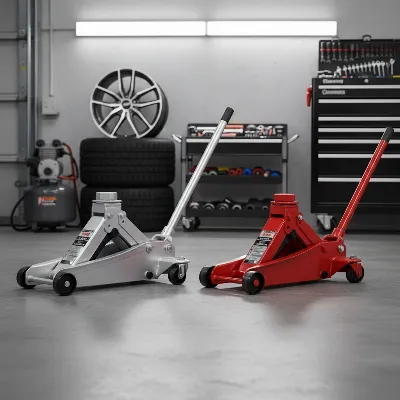 A side-by-side visual comparison of a sleek, silver aluminum floor jack and a robust, red steel floor jack in a well-lit garage setting. Both jacks are positioned next to each other, highlighting their aesthetic and structural differences. The aluminum jack appears lighter and more refined, while the steel jack looks heavier and more industrial, with automotive wheels and tools in the background.
Hướng dẫn sử dụng Floor Jack an toàn
Working underneath a vehicle always carries inherent risks, making safe floor jack usage non-negotiable. Following proper procedures is crucial to prevent accidents and ensure your well-being. Never take shortcuts when your safety is at stake.
First and foremost, always operate your floor jack on a flat, hard, and stable surface like concrete. Avoid uneven ground, gravel, grass, or inclines, as these can cause the jack to shift, sink, or tip over dangerously. Before lifting, ensure your vehicle is in park (or gear for manual transmissions), the parking brake is engaged, and wheel chocks are placed on the tires that remain on the ground to prevent any movement.
Next, consult your vehicle’s owner’s manual to identify the correct lifting points. These are typically reinforced areas on the frame or specific jack points designed to safely support the vehicle’s weight. Never place the jack under suspension components, fuel tanks, or body panels, which can be damaged or fail catastrophically. Position the jack’s saddle directly and securely under the lifting point, ensuring full contact and a balanced load.
As you lift, pump the handle smoothly and gradually, watching the vehicle’s stability carefully. Never crawl under a vehicle supported solely by a floor jack. Hydraulic systems can fail, and a jack is a lifting device, not a holding device. The moment the vehicle reaches the desired height, immediately place sturdy jack stands under the designated support points, such as the frame rails or axles. Slowly lower the vehicle onto the jack stands until it rests securely, then you can slightly relieve the pressure on the floor jack.
Before starting any work, give your floor jack a quick inspection. Look for any cracks, dents, fluid leaks, or signs of damage. Test the pump mechanism without a load to ensure smooth operation. Also, never exceed the jack’s maximum weight capacity. Using a jack beyond its rated limit is extremely dangerous and can lead to equipment failure and severe injury. By adhering to these safety guidelines, you can perform vehicle maintenance with confidence and peace of mind.
Bảo trì và bảo dưỡng Floor Jack
Regular maintenance and proper storage are vital for extending the lifespan of your floor jack and ensuring its safe, reliable performance for years to come. Neglecting these steps can lead to decreased efficiency, premature wear, or even dangerous malfunctions.
After each use, take the time to clean your floor jack thoroughly. Wipe down all exterior surfaces with a clean, damp cloth to remove dirt, grease, and grime. Pay attention to hard-to-reach areas, such as crevices and joints, using a soft brush or compressed air if necessary. Inspect the wheels and casters, removing any debris like stones or metal shavings that could impede smooth movement. This prevents contaminants from entering the hydraulic system and keeps components moving freely.
Lubrication is another critical aspect of floor jack maintenance. Regularly apply a high-quality, general-purpose grease to all moving parts, including pivots, joints, the pump assembly, caster wheels, front axles, and handle pivot bolts. This reduces friction, prevents premature wear, and ensures smooth operation of the lifting and lowering mechanisms. Ensure that the release valve and control mechanism are also properly lubricated to prevent sticking.
For hydraulic floor jacks, checking and maintaining the hydraulic fluid level is essential. Air can accumulate in the system, reducing efficiency and leading to spongy operation. Periodically, you’ll need to bleed the system to purge any trapped air bubbles. Consult your jack’s user manual for the specific procedure, but it typically involves opening the release valve, pumping the handle several times, then closing the valve. Also, inspect for any signs of fluid leaks, which indicate seal degradation. If necessary, top up or replace the hydraulic oil according to the manufacturer’s recommendations, ensuring you use the correct type of hydraulic mineral oil and never substitute with brake fluid or engine oil, as this can damage the seals.
Finally, proper storage significantly contributes to your jack’s longevity. Always store your floor jack in a clean, dry area to prevent rust and corrosion, keeping it away from extreme temperatures and moisture. When not in use, ensure the jack is fully lowered to relieve pressure on the hydraulic system, which helps prevent strain on the seals and internal components. Avoid storing it on its side, as this can increase the risk of fluid leaks or air entering the system. By adhering to these simple maintenance practices, your floor jack will remain a reliable and safe tool for all your automotive needs.
Conclusion
Choosing between an aluminum and steel floor jack in 2026 is a decision that truly depends on your individual priorities and how you plan to use this essential tool. Aluminum jacks excel in portability, corrosion resistance, and speed, making them ideal for mobile mechanics, racing enthusiasts, and DIYers who value a lightweight, easy-to-maneuver option. Conversely, steel jacks stand as the steadfast workhorses, offering superior durability, stability for heavy loads, and a more budget-friendly price point, perfectly suited for professional shops and those who prioritize robust, long-term performance in a fixed garage setting.
Ultimately, there isn’t a universally “best” option; it’s about identifying which material best aligns with your specific needs, vehicle type, and frequency of use. By carefully considering factors like weight, cost, and desired durability, you can confidently invest in a floor jack that enhances safety, efficiency, and longevity in your automotive projects. Which material will you choose to elevate your garage game this year?
Frequently Asked Questions
Are aluminum floor jacks strong enough for trucks?
Yes, many aluminum floor jacks offer capacities of 2.5 to 3 tons, making them suitable for most light trucks and SUVs. However, for heavy-duty trucks or consistent professional use, steel jacks often provide greater stability and long-term ruggedness. Always check the jack’s specific weight rating against your vehicle’s requirements.
Why are aluminum floor jacks more expensive than steel ones?
Aluminum floor jacks typically cost more due to the higher material processing costs of aluminum alloys and their often more intricate, lightweight designs. They are frequently marketed as premium, performance-oriented tools, contributing to their higher price point compared to standard steel models.
Can I leave a car on a floor jack for an extended period?
No, a floor jack is designed for lifting, not for long-term support. Hydraulic systems can slowly bleed pressure over time, potentially causing the vehicle to lower unexpectedly. Always use certified jack stands to support a vehicle once it has been lifted to ensure safety, even for short tasks.
Do aluminum jacks rust?
Aluminum does not rust in the same way steel does because it forms a protective oxide layer when exposed to air. This natural corrosion resistance is a significant advantage, especially in humid or wet environments. However, aluminum can still corrode under certain conditions, such as prolonged exposure to harsh chemicals or saltwater.
