For any sports car enthusiast or meticulous owner, maintaining your vehicle often means getting underneath it. But with minimal ground clearance, the typical garage jack just won’t cut it. Trying to squeeze a standard floor jack under a lowered suspension can be a frustrating, if not impossible, task. The right low profile floor jack isn’t just a convenience; it’s an absolute necessity for safe and efficient car care. This comprehensive guide will navigate you through everything you need to know about these specialized tools, from their fundamental design to choosing the perfect model for your prized sports car, ensuring you can perform everything from oil changes to intricate suspension work with confidence.
What is a Floor Jack?
A floor jack, also commonly known as a trolley jack, is a hydraulic device designed to lift heavy vehicles off the ground, facilitating maintenance, repairs, or tire changes. Its fundamental mechanism relies on hydraulic pressure: when you pump the handle, it pushes hydraulic fluid through cylinders, which in turn extends a ram to lift the saddle and, consequently, your vehicle. These jacks are preferred over simpler tools like scissor jacks due to their superior stability, ease of use, and higher lifting capacity.
For sports cars and other low-clearance vehicles, a low profile floor jack is absolutely essential. Unlike standard jacks that typically require a minimum clearance of 5 to 7 inches, low profile versions are engineered to slide under vehicles with as little as 3 to 4 inches of space. This is achieved through compact cylinder designs, recessed wheels, and optimized linkage arms that allow the jack’s saddle to sit significantly closer to the ground. This specialized design ensures you can access crucial lifting points on your sports car without needing to resort to ramps or makeshift solutions, which can often be unsafe. Without a low profile jack, working on vehicles like a Corvette or a heavily modified track car would be significantly more challenging, if not impossible, to do safely and effectively.
Types of Floor Jacks on the Market
While the market offers several types of floor jacks, primarily hydraulic, pneumatic, and mechanical, the hydraulic variant, especially in its low-profile configuration, is the undisputed champion for sports car owners. Understanding the differences helps underscore why this specialized tool is indispensable.
Hydraulic Floor Jacks
Hydraulic floor jacks are the most common and versatile type, dominating both professional workshops and home garages. They operate using a hydraulic system, which means they use an incompressible fluid to generate force. Pumping the handle compresses the fluid, which then pushes a piston to lift the vehicle.
- Advantages: For sports cars, hydraulic low profile jacks offer several key benefits. They provide significant lifting power with minimal effort, making quick work of raising even heavy vehicles. Their controlled lifting and lowering mechanisms enhance safety, and many feature rapid pump designs that get your car off the ground in just a few strokes. Moreover, the prevalence of low-profile hydraulic designs means a wide selection specifically tailored for vehicles with limited ground clearance. Many models combine steel and aluminum for durability and lighter weight, making them both robust and portable.
- Disadvantages: They can be heavier and bulkier than other types, potentially taking up more storage space. Higher-end models, particularly those made with lighter aluminum, can also be a significant investment.
- Applications: Ideal for virtually any automotive maintenance task, from routine oil changes and tire rotations to more extensive engine or suspension work on sports cars, sedans, and light trucks.
|
Our Picks for the Best Floor Jack in 2026
As an Amazon Associate I earn from qualifying purchases.
|
||
| Num | Product | Action |
|---|---|---|
| 1 | 3 Ton Floor Jack (6600 lbs), Heavy Duty Hydraulic Jack for Car, Heavy-Duty Floor Jack with Single Piston Pump, Quick Lift Car Jack 3 ton with Lifting Range 5.5'' to 18.5'' |

|
| 2 | DNA Motoring Low Profile Hydraulic Trolley Service/Floor Jack, 2 Ton (4000 lbs) Capacity, Lifting Range 5.1"-13", Blue, TOOLS-00474 |
|
| 3 | Low Profile Floor Jack 3 Ton (6600 lbs), Heavy Duty Hydraulic Jack for Car, Heavy-Duty Floor Jack with Dual Pistons Quick Lift Pump, Car Floor Jack with Lifting Range 3-1/8'' to 19-7/8'' |
|
| 4 | Floor Jack 3 Ton Capacity Fast Lift Service Jack Steel Heavy Duty Hydraulic Car Jack |
|
| 5 | Dewalt DWHT83550 TOUGHSERIES Construction Jack |
|
| 6 | 3 Ton Low Profile, Aluminum and Steel Racing Floor Jack with Dual Pistons Quick Lift Pump for Sport Utility Vehicle, Lifting Range 3-15/16" min to 18-5/16" max, Net Weight 58.5 lb, Red |
|
| 7 | Amazon Basics Hydraulic Floor and Portable Car Jack, 2.2 Short Ton/ 2 Metric Ton/ 2 Tonne / 2000 kg Capacity, Slow Release, Red |
|
| 8 | Floor Jack 2.5 Ton (5500 lbs), Low Profile Floor Jack with Single Piston Pump, Heavy Duty Steel Hydraulic Jack for Car, Jack for Car with Lifting Range 3.4'' to 14.6'' |
|
| 9 | VEVOR 2.5 Ton Low Profile, Heavy-Duty Steel Racing Floor Jack with Single Piston Lift Pump, Lifting Range 3.35"-14.96" |
|
| 10 | DNA Motoring TOOLS-00234 Low Profile Hydraulic Trolley Service/Floor Jack, 2 Ton (4000 lbs) Capacity, Lifting Range 5.1"-13", Black |
|
Pneumatic Floor Jacks
Pneumatic floor jacks, often referred to as air jacks, utilize compressed air to lift vehicles. These are less common in home garages due to the requirement for an air compressor but are highly valued in professional settings.
- Advantages: Their primary benefit is speed and efficiency. They can lift a vehicle incredibly fast with minimal physical effort, simply by connecting to an air line. They are particularly useful in busy shops or for track day enthusiasts who need quick tire changes or inspections between sessions.
- Disadvantages: They require an air compressor, which adds to the initial cost and equipment footprint. They can also be quite noisy in operation.
- Applications: Primarily used in large repair shops, race garages, or production lines where speed and repetitive lifting are paramount. While some low-profile pneumatic options exist, they are often overkill for the average sports car owner.
Mechanical Floor Jacks
Mechanical floor jacks, such as scissor jacks, rely on mechanical advantage rather than hydraulics or air pressure. They typically use a screw mechanism or a lever system to manually lift the vehicle.
- Advantages: They are generally the most compact, lightweight, and least expensive option. Their simplicity means fewer parts to fail, making them relatively reliable for emergency situations.
- Disadvantages: They require significant manual effort to operate, have limited lifting capacity, and often offer a slower and less stable lift compared to hydraulic jacks. Most importantly for sports cars, their minimum saddle height is often too high, and their reach too short, making them unsuitable for regular use on low-clearance vehicles.
- Applications: Best suited for emergency tire changes on the roadside or very light-duty, infrequent use on vehicles with standard ground clearance. They are generally not recommended for sports cars or any serious garage work.
For sports cars, the clear winner is the hydraulic floor jack, especially models explicitly designed for low-profile applications. They strike the perfect balance of power, control, and accessibility, making them the safest and most practical choice for dedicated enthusiasts.
 A sleek, red low profile floor jack positioned under a sports car in a clean garage.
Comparing Low Profile Floor Jacks
When selecting a low profile floor jack for your sports car, several key specifications differentiate models and impact their suitability. The following table provides a comparison of some highly-rated low profile options commonly considered by enthusiasts.
| Feature / Model | Capacity (Tons) | Min Height (inches) | Max Height (inches) | Material | Key Features |
|---|---|---|---|---|---|
| Pittsburgh 3-Ton Low-Pro Aluminum Racing Jack | 3 | 3.75 | 18.25 | Aluminum | Lightweight (approx. 63 lbs), dual parallel pump system for quick lifting, low profile design ideal for lowered vehicles, reinforced lifting arm. |
| Arcan 3-Ton Hybrid Low Profile Jack | 3 | 3.75 | 18.5 | Aluminum & Steel | Blends aluminum for portability and steel for strength, dual pump pistons for rapid lifting, long reach to access deep lift points, rubber saddle to protect vehicle frame. |
| Pro-Lift F-767 Floor Jack | 2 | 3.8 | 15 | Steel | Budget-friendly, compact size, bypass device to prevent over-pumping, robust steel construction for durability, suitable for occasional use. |
| Torin Big Red AT825010B Low Profile Jack | 2.5 | 3.5 | 14.5 | Alloy Steel | Single-piston quick lift pump, safety bypass system, 360-degree swivel casters for maneuverability, durable steel construction. |
| Harbor Freight Daytona 3-Ton Long Reach Low Profile Jack | 3 | 3.25 | 24.25 | Heavy-Duty Steel | Often compared to premium brands, rapid pump system, foot pedal for fast positioning, exceptionally long reach, wide lift range suitable for various vehicles including very low sports cars and higher SUVs. |
| Sunex 6602LP Ultra Low Profile Jack | 2 | 2.75 | 24 | Steel | Ultra-low profile, extremely long chassis for deep reach, high maximum lift, often praised by race car owners for extreme low clearance. |
- Saddle Height (Minimum/Maximum): This is paramount for sports cars. The minimum height dictates if the jack can even slide under your vehicle, especially with aftermarket suspensions. A lower minimum height (e.g., 2.75″ to 3.75″) is highly desirable. The maximum height determines how much clearance you’ll have to work with. For sports cars, a maximum lift of 18-24 inches is usually sufficient to get wheels off the ground and allow ample workspace.
- Weight Capacity: Most sports cars weigh between 2,500 to 4,000 lbs (1.25 to 2 tons). A 2-ton (4,000 lbs) capacity jack is generally sufficient, but a 3-ton (6,000 lbs) jack provides a safer margin, especially considering the general rule of thumb to choose a jack with 1.5 times your vehicle’s weight capacity. Overloading a jack is extremely dangerous and can lead to catastrophic failure.
- Material:
- Aluminum Jacks: Lightweight, corrosion-resistant, and easier to maneuver, making them excellent for portability and track days. They are often more expensive. Examples include the Pittsburgh and Arcan aluminum variants.
- Steel Jacks: Heavier and typically more durable, often offering better stability for heavy lifting. They are generally more affordable but less portable. The Daytona and Sunex models are robust steel options. Hybrid jacks (aluminum and steel) offer a balance of both.
- Hydraulic System & Pump Speed: Look for dual-piston or rapid pump systems. These designs lift the vehicle faster and with fewer strokes of the handle, saving time and effort.
- Long Reach: Many sports cars have central jacking points further under the chassis. A jack with a longer chassis or reach is beneficial to access these points safely without damaging bodywork. The Arcan Hybrid, Daytona, and Sunex 6602LP are noted for their impressive reach.
> “For a sports car, don’t just look at the ‘low profile’ label. Always check the actual minimum saddle height and ensure it clears your vehicle’s lowest points. A few millimeters can make all the difference.” – Admin, ReviewHoster.com, Hydraulic Jack Technician
How to Choose the Right Low Profile Floor Jack
Selecting the ideal low profile floor jack for your sports car involves a careful assessment of your specific needs and the jack’s features. It’s an investment in safety and convenience.
Determine Your Needs
Before diving into specifications, consider how and where you’ll be using the jack.
- Type of Vehicle (Weight & Clearance): Your sports car’s curb weight is the primary factor for capacity. For instance, a lightweight Mazda MX-5 might be fine with a 2-ton jack, while a heavier Porsche 911 or a modified track car might warrant a 3-ton capacity. Crucially, measure your vehicle’s ground clearance at its lowest points (e.g., pinch welds, subframe) to ensure the jack’s minimum height is compatible. Remember that even a slight rake or angle can reduce effective clearance.
- Frequency of Use: If you’re a weekend warrior who only changes oil once a year, a robust steel jack might be sufficient. However, if you’re frequently at the track, swapping tires, or doing extensive modifications, a lighter, faster aluminum or hybrid jack with a rapid pump system will save you time and effort.
- Budget: Low profile jacks range from budget-friendly steel models to premium, lightweight aluminum versions. Define your budget early, but prioritize safety and functionality over cost. A cheap, inadequate jack is a dangerous one.
Key Factors to Consider When Choosing
Once your needs are clear, focus on these critical specifications and features:
- Lifting Capacity (Maximum Load): As a general rule, choose a jack with a lifting capacity at least 1.5 times the weight of the heaviest vehicle you intend to lift. For most sports cars, a 2-ton (4,000 lbs) jack is adequate, but a 3-ton (6,000 lbs) jack offers a greater safety margin and versatility. Never exceed the jack’s stated capacity.
- Lifting Height (Minimum and Maximum): This is arguably the most critical factor for low profile sports cars.
- Minimum Height: This dictates whether the jack can slide under your vehicle. Look for models with a minimum saddle height of 3.75 inches or less, with ultra-low models going down to 2.75 inches for exceptionally lowered cars.
- Maximum Height: Ensure the jack can lift your car high enough to get the wheels completely off the ground and allow comfortable working space beneath. A range of 18 to 24 inches is generally sufficient.
- Durability and Quality of Materials:
- Steel: Typically heavier, more durable, and generally less expensive. Great for stationary garage use.
- Aluminum: Lighter (often 30% lighter than steel equivalents), corrosion-resistant, and easier to transport. Ideal for mobile mechanics or track day enthusiasts.
- Hybrid (Steel & Aluminum): Offers a balance of strength and portability.
Look for robust construction, strong welds, and high-quality finishes that resist rust and wear.
- Brand and Supplier Reputation: Reputable brands often offer better warranties, readily available replacement parts, and reliable customer support. Research user reviews and professional endorsements. Brands like Arcan, Pittsburgh, Torin, Sunex, and Daytona (Harbor Freight) are frequently mentioned in discussions about quality floor jacks.
- Safety Features:
- Overload Protection (Bypass Valve): Prevents damage to the jack and potential accidents by preventing lifting beyond its rated capacity.
- Wide Base/Chassis: Provides greater stability, reducing the risk of the jack tipping over, especially when lifting.
- Rubber Saddle Pad: Protects your vehicle’s undercarriage from scratches and damage at the lifting point.
- Locking Mechanism: Some jacks offer a mechanical lock once lifted, providing an extra layer of security.
- Pump Speed and Effort: Dual-piston or “rapid pump” designs lift vehicles faster with fewer strokes, which is a significant convenience.
- Handle Ergonomics and Length: A comfortable, often padded, handle makes pumping easier. A longer handle can provide more leverage, reducing effort, but ensure it fits your workspace. Some handles are two-piece for easier storage.
Top Brands for Low Profile Floor Jacks
Several manufacturers consistently receive high praise for their low profile floor jacks, catering specifically to the needs of sports car owners.
- Pittsburgh (Harbor Freight): Their “Low-Pro Aluminum Racing Jack” (and the steel Daytona series) is a popular choice, praised for its balance of low profile, quick lift, and competitive pricing. It’s a strong contender for those seeking value without compromising performance.
- Arcan: Known for producing robust and reliable hydraulic jacks, Arcan offers excellent hybrid and aluminum low profile options. Their jacks are often highlighted for their durability, long reach, and fast lifting capabilities, making them a premium choice for serious enthusiasts.
- Sunex: The Sunex 6602LP stands out for its ultra-low profile and exceptionally long reach, making it a favorite among owners of extremely lowered or race-prepped vehicles. It’s often considered a benchmark for accessing hard-to-reach jacking points.
- Pro-Lift: The Pro-Lift F-767 is a budget-friendly steel option that still offers a respectable low profile, making it a good entry point for occasional use on moderately lowered vehicles.
- Torin (Big Red): Offers a range of durable steel jacks, including low profile models like the AT825010B. These jacks are generally reliable and offer good value for money, with features like bypass systems for safety.
- Jack Boss / VEVOR: These brands often provide competitive options with good features, typically emphasizing durable steel construction and appealing to those looking for strong performance at a more accessible price point.
When choosing, always cross-reference brand reputation with specific model reviews to ensure the jack meets your sports car’s unique requirements.
How to Safely Use Your Floor Jack
Using a floor jack, especially with a low-clearance sports car, demands meticulous attention to safety. Improper use can lead to serious injury or severe vehicle damage. Always remember: never rely solely on a floor jack to support a vehicle when working underneath it. Jack stands are indispensable.
-
Preparation is Key:
- Flat, Level Surface: Always work on a hard, flat, and level surface, ideally concrete. Gravel, dirt, grass, or sloped driveways can cause the jack to shift or sink, leading to instability.
- Engage Parking Brake: Ensure your vehicle’s parking brake is fully engaged.
- Wheel Chocks: Place wheel chocks on the tires that will remain on the ground (e.g., if lifting the front, chock the rear wheels). This prevents the vehicle from rolling.
- Consult Your Vehicle Manual: Locate the manufacturer-recommended jacking points. These are typically reinforced areas on the frame or subframe, designed to safely bear the vehicle’s weight. Never lift on suspension components, sheet metal, or plastic trim, as these can easily bend or break.
- Clear the Area: Remove any obstacles or tools from around and under the vehicle.
-
Positioning the Jack:
- Slide Under Carefully: With your low profile jack, carefully slide it under the vehicle until the saddle is directly beneath the designated jacking point. Ensure the jack’s wheels are free to roll as the vehicle lifts. Floor jacks arc slightly as they lift; if the wheels cannot move freely, the jack can “walk” and become unstable.
- Center the Load: Make sure the jacking point is centered on the jack’s saddle to distribute the weight evenly. Many low profile jacks come with a rubber pad to protect the vehicle’s pinch welds or frame rails.
-
Lifting the Vehicle:
- Slow and Steady: Pump the jack handle slowly and smoothly, watching the vehicle as it rises. Look for any signs of instability, shifting, or uneven lifting.
- Lift Only as Needed: Raise the vehicle just enough to perform your task and allow sufficient clearance for jack stands.
- Position Jack Stands: Once the vehicle is at the desired height, immediately slide jack stands under reinforced frame points adjacent to your lifting point. Position them securely.
- Lower onto Stands: Slowly and carefully release the pressure on the floor jack, lowering the vehicle until its weight rests entirely on the jack stands. The jack should now be lightly loaded or removed, serving only as a backup.
- Test Stability: Before getting under the vehicle, gently push or rock it to ensure it is stable and securely supported by the jack stands.
-
Lowering the Vehicle:
- Re-Engage Jack: If you removed the jack, carefully slide it back under the original jacking point and raise the vehicle slightly to take the weight off the jack stands.
- Remove Jack Stands: Once the jack is supporting the vehicle’s weight again, remove the jack stands.
- Slow and Controlled Lowering: Slowly open the release valve on the jack to gradually lower the vehicle to the ground. Maintain control throughout the process, ensuring the car settles smoothly.
- Remove Jack and Chocks: Once the car is fully on the ground, remove the floor jack and wheel chocks.
Following these steps meticulously every time you lift your sports car will significantly enhance safety and prolong the life of both your vehicle and your valuable tools.
Maintenance and Care for Your Floor Jack
Proper maintenance is crucial for ensuring the longevity, reliability, and safe operation of your low profile floor jack. Neglecting these simple steps can lead to premature wear, performance issues, and even dangerous failures.
-
Keep It Clean:
- After Each Use: Wipe down your floor jack after every use with a damp cloth to remove dirt, dust, grease, brake dust, and fluid spills. Pay close attention to moving parts, wheels, and seals.
- Stubborn Grime: For stubborn grease or oil, use a mild cleaner. Always dry the jack thoroughly to prevent rust and corrosion.
- Air Blasting: A shot of compressed air can help clear debris from tight spaces around pistons and casters.
-
Check for Hydraulic Fluid Leaks:
- Hydraulic jacks rely on a sealed system. Any leaks can compromise performance and safety.
- Indicators: Look for pooled fluid under the jack, slow or uneven lifting, or a “spongy” feel when pumping the handle.
- Inspection: Regularly inspect the entire jack for any visible signs of fluid seepage, particularly around seals and connections.
-
Top Off Hydraulic Fluid (If Needed):
- Fluid levels can naturally drop over time. Maintaining the correct fluid level ensures optimal lifting power.
- How to Check: Fully lower the jack. Locate and remove the fill plug (usually on the reservoir). The fluid level should be flush with the bottom of the fill hole.
- Refill: Use only hydraulic jack oil (e.g., ISO VG 32 or AW32). Never use brake fluid, motor oil, or transmission fluid, as these can damage the jack’s internal seals and components, leading to failure.
- Bleeding Air: If the jack feels spongy or lifts unevenly after refilling, you may need to bleed air from the hydraulic system. This typically involves opening the release valve, pumping the handle a few times, then closing the valve. Consult your jack’s manual for specific instructions.
-
Lubricate Moving Parts:
- Just like any mechanical device, a jack has moving components that benefit from lubrication.
- Application: Apply a light layer of grease to pivot points, axles, and wheels. Lightly oil the handle socket and the threads of the release valve.
- Caution: Avoid over-lubricating around the piston/seal area, as this can attract dust and debris.
-
Proper Storage:
- Lowered Position: Always store your jack fully lowered to relieve pressure on the hydraulic system. This extends the life of the seals.
- Dry, Clean Environment: Keep the jack in a dry, clean place to prevent rust and corrosion. Moisture is a primary enemy of steel components.
- Cover It: If possible, cover the jack or store it in a cabinet to protect it from dust and humidity.
- Upright Position: Store hydraulic jacks on their base, not on their side, to prevent air from entering the hydraulic system.
By adhering to these maintenance tips, your low profile floor jack will remain a reliable and safe tool for years of service, ready whenever your sports car needs attention.
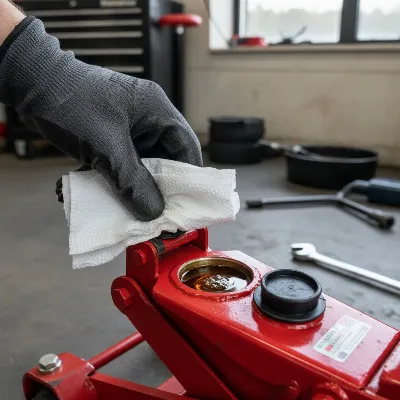 Close-up of a hand checking hydraulic fluid on a floor jack during maintenance.
Conclusion
For the discerning owner of a sports car, a high-quality low profile floor jack is more than just a tool—it’s an indispensable partner in maintaining your vehicle’s peak performance and aesthetics. We’ve explored how these specialized jacks provide the critical clearance needed for lowered vehicles, offering safe and efficient access for all your automotive needs. From understanding the core differences in materials and hydraulic systems to mastering safe operating procedures and essential maintenance, you now have the knowledge to make an informed decision.
Remember, the right floor jack combines adequate lifting capacity, an ultra-low minimum height, and durable construction, all backed by robust safety features. Whether you opt for the lightweight portability of an aluminum jack or the sturdy reliability of a steel model, prioritizing these factors ensures you select a tool that meets the rigorous demands of your sports car. Don’t compromise on safety or functionality; your passion for your vehicle deserves the best support. What specific modification or maintenance task are you most looking forward to tackling with your new low profile floor jack?
Frequently Asked Questions
What makes a floor jack “low profile” and why is it important for sports cars?
A low profile floor jack is designed with a minimal saddle height, typically 3 to 4 inches or less, allowing it to slide under vehicles with very limited ground clearance. This is crucial for sports cars, which often have lowered suspensions, preventing damage to the bodywork or undercarriage when attempting to reach jacking points.
What weight capacity should I look for in a low profile floor jack for my sports car?
For most sports cars, a 2-ton (4,000 lbs) capacity is usually sufficient, as many sports cars weigh less than 4,000 lbs. However, opting for a 3-ton (6,000 lbs) jack provides a greater safety margin and versatility for heavier vehicles or future needs. Always choose a jack with a capacity at least 1.5 times your vehicle’s weight.
Is an aluminum or steel low profile floor jack better?
Both have advantages. Aluminum jacks are lighter, making them more portable and easier to maneuver, ideal for track days or mobile use. They are also corrosion-resistant. Steel jacks are typically heavier, more durable, and generally more affordable, offering robust stability for garage use. The “better” choice depends on your priorities for portability versus budget and maximum durability.
Can I use a standard floor jack with wood blocks to lift my sports car?
While some people use wood blocks to gain clearance for a standard jack, it is not recommended due to significant safety risks. Wood blocks can split, shift, or become unstable, leading to the vehicle falling. A proper low profile floor jack is engineered for safe, direct contact with the vehicle’s jacking points.
What are the most important safety features to look for?
Prioritize jacks with an overload protection (bypass) valve to prevent lifting beyond capacity, a wide and stable chassis for balance, and a rubber saddle pad to protect your vehicle’s frame. Always use jack stands to support the vehicle after lifting, never rely solely on the jack.
How often should I perform maintenance on my floor jack?
Regular maintenance, including cleaning after each use, checking for fluid leaks, and lubricating moving parts, should be done routinely. Hydraulic fluid levels should be checked periodically (e.g., every 6-12 months or as per the manufacturer’s manual) and topped off or changed as needed, and the system bled if it feels spongy.
Can a low profile jack also lift taller vehicles like SUVs?
Many 3-ton low profile jacks have a sufficient maximum lift height (e.g., 18-24 inches) to also lift SUVs or trucks, provided their minimum height allows them to fit under the vehicle and reach the jacking points. However, their long reach might be less practical for high-clearance vehicles where lift points are easily accessible closer to the edge.
